To make spore prints, select a mature mushroom and carefully place the cap—gills or pores facing down—on a clean, contrasting surface. Cover it to prevent air disturbance and wait 12-24 hours for spores to fall and form a pattern. Spore prints help identify mushroom species based on color and pattern, which is essential for safe foraging. Keep these steps in mind, and you’ll discover how simple it is to learn more about mushrooms.
Key Takeaways
- Making a spore print involves placing the mushroom cap gills-down on a surface to collect spores naturally released.
- Spore prints help identify mushroom species by revealing unique color, pattern, and density of spores.
- Use a clean, contrasting surface and cover the cap to prevent airflow disturbance during the process.
- Allow 12-24 hours for spores to fall and form a clear, detailed pattern for accurate identification.
- Proper spore printing aids safe foraging by confirming mushroom identity through visual and microscopic features.
Gathering Materials and Preparing Your Workspace

Before you begin collecting spores, you need to gather the right materials and set up a clean, organized workspace. Understanding mushroom ecology helps you appreciate how spores disperse naturally, so you can replicate that process effectively. You’ll need a few basic supplies: a white or dark background, a glass or bowl, and clean tools like tweezers or a knife. Make certain your workspace is free of dust and contaminants to prevent mold or unwanted microorganisms from affecting your spore print. Using a well-prepared environment mimics natural spore dispersal, making it easier to collect clear, vibrant prints. Proper setup helps you observe the delicate process of spore release and ensures your results are accurate and free from external interference. Additionally, understanding regional divorce laws can be beneficial if you’re managing legal aspects alongside your mushroom cultivation.
Selecting and Removing the Mushroom Cap
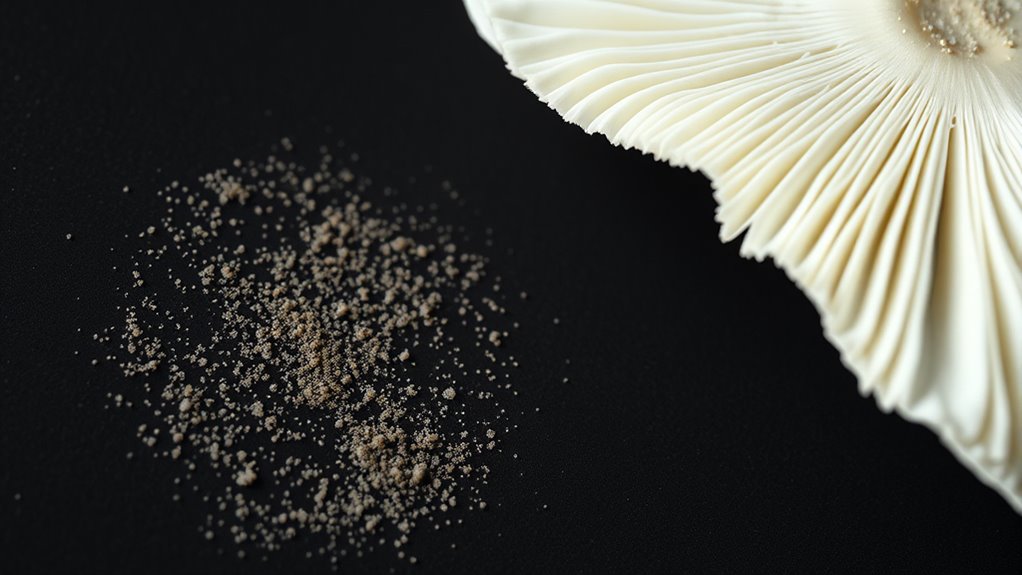
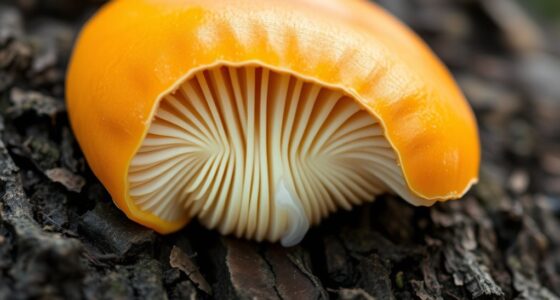
Choosing the right mushroom cap is vital for obtaining a clear and vibrant spore print. When selecting, examine the mushroom anatomy closely—look for a mature cap with evenly colored gills or pores, as these are key for effective spore dispersal. To remove the cap properly:
- Gently grasp the mushroom by the stem, avoiding damage to the cap.
- Twist or lift the cap carefully to detach it without tearing the gills or surface.
- Place the cap, gills down, on your prepared surface to start the spore print process.
Handling the cap with care ensures you preserve the delicate spore-producing structures. Proper selection and removal maximize spore release, capturing the full spectrum of colors and patterns vital for identification and study. Additionally, visual inspection helps confirm the maturity of the cap, ensuring a successful spore print.
Creating the Spore Print
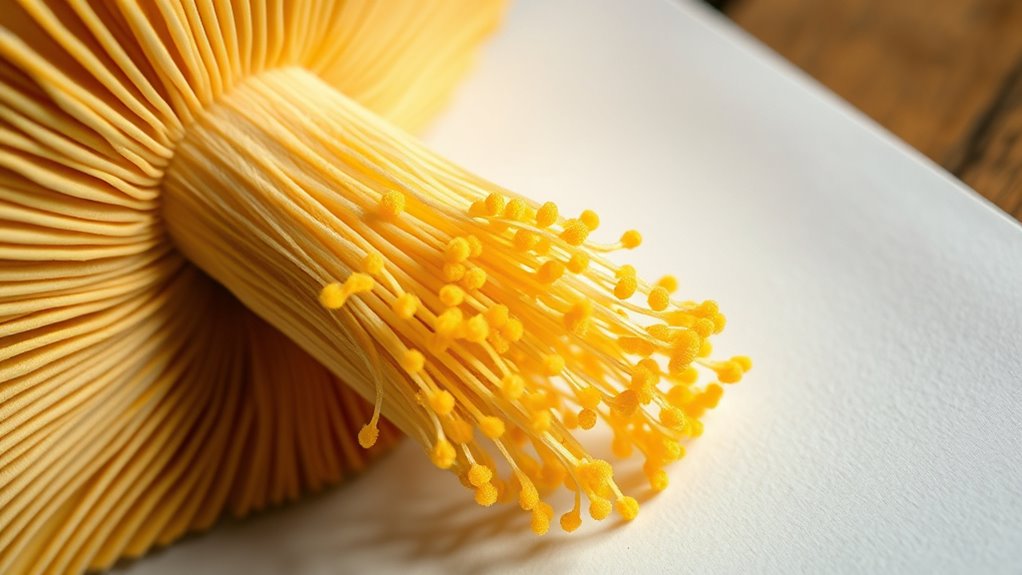
To create a spore print, place the mushroom cap, gills or pores facing downward, on a clean sheet of paper or other suitable surface. Cover it with a bowl or cup to prevent airflow disturbance. After several hours, spores will fall, forming a pattern. The resulting print reveals various spore print colors, which are essential for mushroom identification. Visualize the process with this imagery:
| Mushroom Cap | Spore Drop | Spore Pattern |
|---|---|---|
| Wide, flat | Falling | Fine dust |
| Curled edges | Collecting | Fanned out |
| Pores visible | Landing | Central dot |
| Gills facing down | Spread | Varied hues |
This method captures a unique fingerprint of your mushroom, aiding in accurate identification and ensuring safe foraging.
Interpreting and Using Your Spore Print
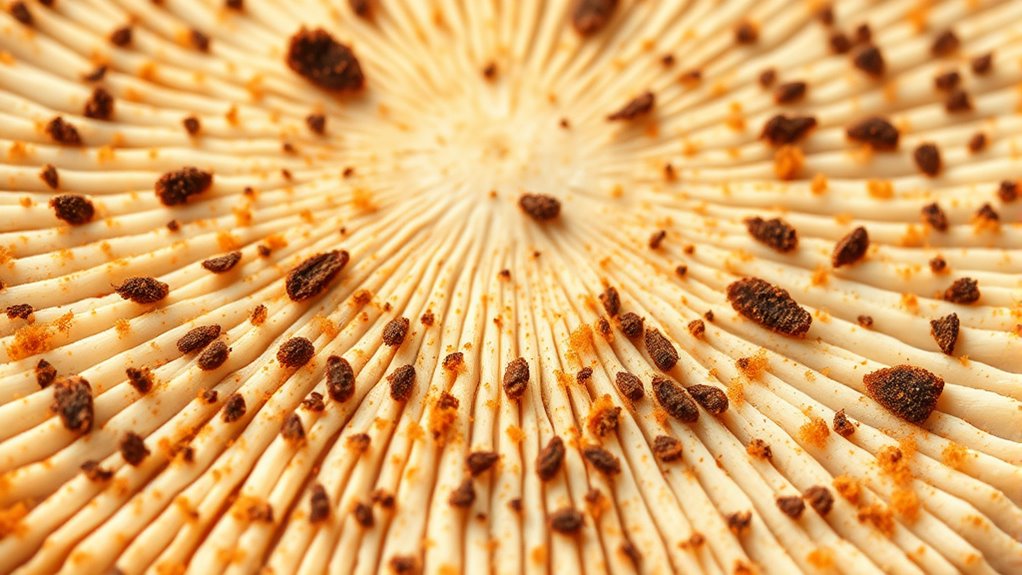
Once you’ve collected your spore print, examining its color and pattern provides vital clues for identifying the mushroom. The spore print color reveals important information about the species, helping you narrow down possibilities. The spore pattern identification can distinguish between lookalikes and confirm your guess. To interpret your print effectively, focus on these key aspects:
- Note the spore print color—it’s often the first step in identification and can be surprisingly distinctive.
- Observe the spore pattern—whether it’s dense, sparse, or forming specific shapes, these details matter.
- Compare with reference guides—match your findings with trusted images and descriptions for accurate identification.
- Understand the significance of microscopic features—certain key microscopic traits, such as spore size and shape, can further refine your identification which enhances the accuracy.
Using these clues, you can confidently analyze your spore print and make informed decisions about your mushroom foraging.
Tips for Accurate and Successful Spore Printing
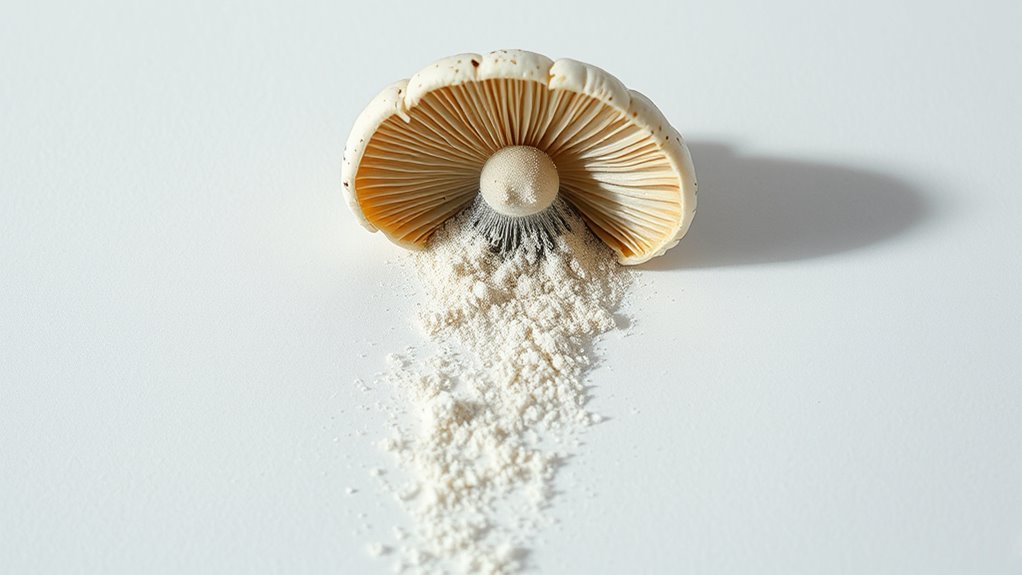
Achieving accurate and successful spore prints hinges on proper technique and attention to detail. First, choose a mature mushroom with fully developed gills or pores. Place it cap-side down on a clean, non-porous surface like glass or paper, ensuring no debris touches the print area. Cover it with a cup or container to create a controlled environment. This helps with spore print preservation and enhances spore color variations. Keep it undisturbed for 12-24 hours. When finished, lift the cap carefully to avoid smudging. To ensure consistent results, use contrasting paper colors, which highlight spore color variations. Proper handling and timing are key for clear, accurate prints that reflect the mushroom’s true spores. This attention to detail improves both your spore print preservation and identification accuracy.
Frequently Asked Questions
How Long Does It Take for a Spore Print to Develop Fully?
You’ll see a spore print develop fully in about 24 hours, but it can take up to 48 hours for the spores to fully settle and reveal their true color. During this time, keep an eye on the spore color to identify the mushroom species. Once finished, store your print in a cool, dry place, and guarantee proper print storage to preserve its quality for future use or identification.
Can Spore Prints Be Used for DNA Analysis or Genetic Research?
You might find it surprising, but spore prints can indeed be used for DNA extraction and genetic identification. When you collect a spore print, you capture genetic material from the fungi, enabling researchers or enthusiasts to analyze its DNA. This process helps verify species, study genetic diversity, and conduct research. So, your spore print isn’t just a visual record; it’s a valuable resource for scientific exploration and accurate identification.
Are There Any Safety Concerns When Handling Mushroom Spores?
When handling mushroom spores, you should prioritize lab safety and contamination prevention. Spores can carry harmful bacteria or toxins, so always wear gloves, a mask, and work in a clean environment. Avoid inhaling spores directly, and sterilize your tools afterward. Proper safety measures help protect you from potential risks and guarantee your samples remain uncontaminated, making your research safer and more reliable.
How Do Environmental Factors Affect Spore Print Quality?
Environmental factors greatly influence your spore print quality. Too much moisture impacts the print by causing mold or blurred spores, while dryness leads to weak or incomplete prints. Light influences spore color and visibility—excess light can fade spores, making prints less distinct. You should find a balanced environment, with controlled moisture and minimal light, to guarantee your spore prints are clear, vibrant, and useful for identification or cultivation.
Can You Make Spore Prints From Dried or Preserved Mushrooms?
Yes, you can make spore prints from dried or preserved mushrooms, but it’s more challenging. Dried mushroom identification relies on examining spores, so making a print from a preserved mushroom helps confirm its species. Use preserved mushroom techniques to rehydrate slightly if needed, then follow standard spore print steps. Keep in mind, dried specimens may produce less vibrant prints, but they still offer valuable identification clues.
Conclusion
Now that you’ve mastered spore printing, you’re basically a mushroom whisperer, capable of capturing their tiny, elusive secrets. Imagine yourself as a covert agent with a secret ink, revealing hidden messages from the mushroom’s underworld. With your newfound skills, you’ll turn mundane caps into mysterious maps of spore treasure. Who knew that a simple sheet of paper could access the fungal universe? Happy printing, and may your spores always land on the right side of science!