
TL;DR
IdeaClyst acts as a virtual war room—an organized space that combines AI-powered critique, discovery, and planning—helping teams validate ideas faster, reduce costly mistakes, and stay focused. Its local-first design keeps your data private and under your control.
Ever had a flood of ideas, each promising but none quite ready? You’re not alone. Most founders wrestle with decision paralysis—trying to pick the best idea without clear evidence or a structured process.
What if you could create a dedicated space that sharpens your focus, surfaces hidden risks, and guides you from rough concept to solid plan—all without leaving your laptop? That’s what IdeaClyst offers—a digital war room built for startup founders and teams hungry for clarity and confidence.
This isn’t just about brainstorming; it’s about transforming chaos into clarity. In this article, you’ll learn how IdeaClyst functions as a virtual war room, how it helps you make smarter decisions faster, and how you can build a similar setup for your projects.
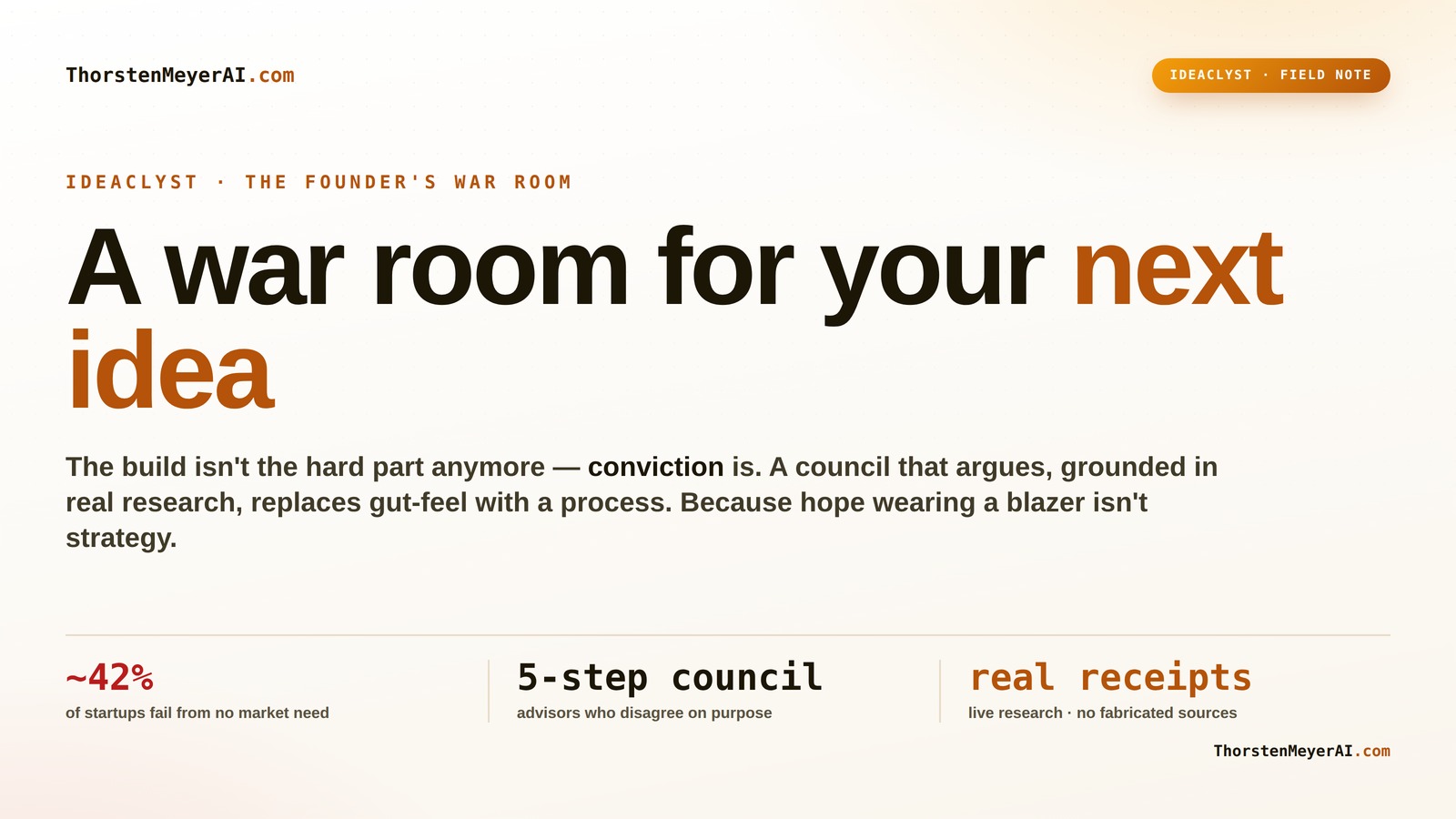
A war room for your next idea
The build isn’t the hard part anymore — conviction is. Knowing which idea deserves the next six months, and being able to defend it. Most founders answer with gut feel and optimistic math. That’s hope wearing a blazer. IdeaClyst replaces it with a process.
The most expensive decision is what to build
The single most valuable thing a tool can do is talk you out of the wrong six months. The numbers make the case better than any pitch.
Three tools in one — on your own machine
Strip away the framing and IdeaClyst is three things at once, all running locally with nothing leaving your laptop.
An AI council
Pressure-tests an idea you bring it — advisors who argue on purpose.
A discovery engine
Finds ideas you didn’t know to look for by hunting real demand signals.
A founder’s workspace
Carries winners from “interesting” all the way to “ready to build.”
Advisors who disagree on purpose
Not one confident, agreeable answer — a structured five-step deliberation where models play different roles and turn on their own work. The disagreement is the feature.
The five-step deliberation
A council that leads with the bad news surfaces the objections you’d otherwise find the expensive way, on month five.
Product strategy
Who’s it for, what’s the wedge, why now, what’s the business model.
Technical architecture
What would it actually take to build — and where’s the risk.
Critique pass
The council turns on its own work. Where’s the hand-waving? What kills this?
Second, independent critique
A different voice, a different angle — so blind spots don’t survive.
Final synthesis
Everything into one coherent founder packet: strategy, architecture, validation, plan.
When IdeaClyst cites a source, it actually fetched it
The hard departure from “ask an AI what it thinks of my startup.” It runs in a strict, real-data-only mode — if it can’t gather genuine evidence, it says so plainly rather than inventing a plausible paragraph.
Confidence with receipts
No fabricated statistics, no imaginary competitors, no made-up citations. The packet survives a skeptical co-founder or a sharp investor because the reasoning has receipts.
Market research first
Scouts the landscape before the council reasons about anything.
Competitor read
Real positioning, pricing signals, feature claims — differentiation vs. reality.
Validation with links
Not “talk to customers” — concrete signals & sources you can click.
From the blank page to build-ready
Evaluation is half the problem; the blank page is the other half. And a plan is worthless if it dies in a tab you never reopen.
Bring a space, not an idea
“AI for accountants,” “tools for indie game studios” — plus your goal and real capacity. It hunts demand signals across HN, Reddit, Product Hunt, GitHub, pricing pages.
- An honest market read — leads with the bad news when a space is hard
- An opportunity map — high pain, thin competition
- Ranked candidates — wedge, who pays, effort, risk, confidence
- each with KILL CRITERIA — when to walk away
A home and a forward path
Every promising idea gets carried forward, with every artifact in plain files on your disk.
- Validation tooling — sprint board, interview list, evidence browser
- Founder profile — a personal-fit lens; same discovery, different advice
- Build workspaces — funnel, personas, landing draft, version history
- “Build this idea” → a PRD + task queue, ready for a coding agent
Key Takeaways
- A digital war room like IdeaClyst centralizes idea validation, reducing costly mistakes and speeding up decision-making by up to 70%.
- Grounding AI critique in live web research prevents false confidence—making your validation process more reliable.
- Structured workflows—from rough notes to final plans—transform chaos into clarity, saving weeks of indecision.
- A local-first setup keeps your data private, giving you full control over your ideas and plans.
- Hybrid war rooms combine physical and digital spaces, making remote collaboration seamless and effective.
digital project management war room software
As an affiliate, we earn on qualifying purchases.
As an affiliate, we earn on qualifying purchases.
What Is a War Room in Innovation? And Why Should You Care?
A war room in innovation is a dedicated space—physical or digital—where teams gather to focus intensely on a single project or idea. It’s a hub for visualizing progress, discussing challenges, and making decisions quickly.
Imagine a startup working on a new app. Instead of scattered Slack messages and endless meetings, they create a digital war room with a shared workspace. Everyone sees the latest research, sketches, and roadblocks in real time. This clarity accelerates decision-making and reduces costly misunderstandings.
According to [2], war rooms support shared memory—keeping everyone on the same page—and foster rapid iteration. They’re especially valuable during critical phases like product launches or pivot decisions. The real power lies in their ability to condense complex, multi-party inputs into a single, coherent narrative. This minimizes the risk of miscommunication, which often causes delays or costly mistakes. However, the tradeoff is that war rooms require discipline to stay focused and well-maintained; otherwise, they can become cluttered and counterproductive, diluting their effectiveness.
How IdeaClyst Turns Your Idea into a Focused War Room
IdeaClyst serves as a digital war room that combines AI-driven critique, idea discovery, and structured planning. It’s designed to help you validate, refine, and prioritize ideas—all in one environment.
For example, you start by inputting a rough idea—say, a new SaaS feature. IdeaClyst’s AI council stage-writes a strategy, challenges assumptions, and suggests improvements. This process is crucial because it pushes you beyond surface-level thinking, uncovering hidden flaws or overlooked opportunities that might not be obvious at first glance. The AI’s critique acts as a mirror, helping you see your idea from different angles, which is vital for avoiding costly pivots later. Then, it finds related ideas or market signals you might have missed, acting as a discovery engine that broadens your perspective and prevents tunnel vision. Finally, it consolidates everything into a clear plan—strategy, architecture, validation tests—stored on your local machine. This comprehensive approach ensures that you’re not just generating ideas but transforming them into actionable, validated plans that align with your goals and resources.
Inside the Workflow: From Rough Notes to Actionable Plans
Picture this: you jot down a vague idea in a note. You feed it into IdeaClyst, which immediately convenes its AI council. Five steps follow, each adding depth and rigor to your original thought:
- Strategy: Who’s the target? Why now? What’s the business model? This step ensures your idea is grounded in real market needs and strategic fit, which is crucial for securing buy-in and resources.
- Architecture: What tech stacks? Risks involved? Clarifying technical details early prevents costly rework and helps identify potential bottlenecks before development begins.
- Critique: Honest feedback—what’s weak or unproven? This step is vital because it exposes assumptions that, if left unchallenged, could lead to failure or wasted effort. It prompts a deeper look into feasibility and market fit.
- Second critique: Different perspective to catch blind spots. This additional layer of review helps you see flaws or opportunities you might have missed, ensuring your plan is robust and resilient.
- Final synthesis: A comprehensive plan stored as Markdown files. This final step consolidates all insights into a single, version-controlled document, making it easier to communicate and execute the idea effectively.
This process turns raw thoughts into a clear, defendable plan—ready for your team or investors. The iterative nature of this workflow encourages continuous refinement, which is essential for high-impact innovation.
Layout & Tools: Building Your Digital War Room
In a physical war room, whiteboards, sticky notes, and movable furniture create a flexible workspace. For a digital setup like IdeaClyst, the focus shifts to structured files, visual boards, and organized research. You can learn more about building effective physical and digital workspaces.
Imagine having a Markdown-based workspace on your laptop—your notes, critiques, and plans all stored locally, versioned, and ready to share. This setup not only supports quick updates and easy review but also significantly enhances security. Unlike cloud-based solutions, local storage ensures your proprietary ideas remain private, mitigating risks associated with data breaches or leaks. The tradeoff is that it requires disciplined organization and manual synchronization, which can be managed with good workflows. Best practices include:
- Keeping dedicated folders for each idea or project to avoid clutter and confusion.
- Using visual tools like digital boards or mind maps for brainstorming, which can help in rapidly visualizing complex relationships and dependencies.
- Regular review sessions to keep the focus sharp and ensure continuous progress.
- Designating a physical or digital space solely for this purpose to foster discipline and consistency.
Whether portable or stationary, the goal is clarity and quick access to every part of your idea’s journey, enabling faster iteration and better decision-making.
Why a War Room Boosts Idea Quality & Speed
Having a dedicated space keeps everyone aligned and accelerates decision-making. When you visualize ideas and challenges, you can quickly identify flaws, dependencies, or gaps that might otherwise go unnoticed until late in development. This early detection reduces rework, delays, and budget overruns. For instance, a team working on a new feature for their app used a digital war room to simulate user flows and identify UX flaws during the planning stage. Catching these issues early allowed them to pivot before investing significant resources, saving six weeks of development time and avoiding potential user dissatisfaction. The clarity provided by visual surfaces empowers teams to make data-driven decisions faster, which is critical in competitive markets. According to [1], visual collaboration tools improve focus and foster collective ownership, which increases motivation and accountability. The tradeoff is that such environments demand discipline: if updates are neglected or clutter accumulates, the benefits diminish, and confusion can ensue. Proper management and regular maintenance are key to sustaining the advantages of a war room environment.
Best Practices & Pitfalls to Avoid
Many teams make the mistake of turning their war room into a cluttered mess. Keep it focused. Dedicate the space to one project at a time, which helps maintain clarity and prevents distraction. Use clear labels, consistent updates, and regular review sessions to keep the environment purposeful and dynamic. Don’t let the room become a dumping ground for random notes or ideas; instead, organize them hierarchically and keep the workspace clean. Visual cues—color coding, icons—help prioritize and quickly convey the status of different ideas or tasks. For remote or hybrid teams, use shared digital boards and set clear protocols for updates to ensure everyone stays aligned. The key is discipline—making the war room a regular habit rather than a one-off event. This consistency ensures continuous momentum and prevents stagnation or confusion. Remember, a cluttered or neglected war room can become a liability, undermining the very clarity and speed it’s meant to foster.
Adapting the War Room for Remote & Hybrid Teams
Remote teams can still benefit from a digital war room—like IdeaClyst—that’s accessible from anywhere. The challenge is maintaining organization and engagement across different locations and schedules. Use cloud-based visual tools combined with local files to ensure everyone can contribute securely and efficiently. Scheduling regular syncs and review sessions helps keep the team aligned, especially when time zones differ. Clear communication protocols and shared standards for updates prevent confusion and ensure consistency. Hybrid setups work best when physical spaces are complemented by digital surfaces—such as a shared digital whiteboard paired with a physical whiteboard in the office. This hybrid approach allows in-person teams to brainstorm and iterate physically while remote members stay engaged through synchronized digital tools. The key is balancing accessibility with structure, ensuring that all team members feel equally involved and informed, which directly impacts the quality and speed of idea development.
Recent Trends: The Evolution of War Rooms in a Digital World
War rooms are no longer confined to physical spaces. Today, digital and portable war rooms are gaining traction, especially with the rise of remote and hybrid work models [1]. These environments leverage online collaboration tools, local storage, and flexible interfaces to mimic the benefits of physical war rooms while offering greater accessibility and scalability. Tools like IdeaClyst exemplify this shift—they blend visual collaboration with local, secure storage, ensuring data privacy and control. Modern war rooms emphasize adaptability: movable layouts, integration with online research sources, and real-time updates tailored to the team’s needs. This evolution means teams can quickly set up, modify, and decommission war rooms based on project demands without the logistical constraints of physical spaces. By embracing digital war rooms, organizations gain agility, reduce setup costs, and foster continuous innovation—making the environment more dynamic and responsive to fast-changing markets.
Frequently Asked Questions
What is IdeaClyst?
IdeaClyst is a local-first, AI-powered tool that acts as a digital war room. It helps founders and teams validate ideas, discover new opportunities, and plan projects—all stored securely on your own machine.
Is IdeaClyst a physical space or a digital tool?
It’s a digital tool designed to mimic the functions of a physical war room, with visual collaboration, structured workflows, and local storage—perfect for remote or hybrid teams.
How does a war room help generate better ideas?
By providing a dedicated, organized space for visualizing, critiquing, and refining ideas, war rooms help teams catch flaws early and build confidence faster—saving time and money.
Can small startups use this approach?
Absolutely. Even small teams benefit from a focused environment. Digital setups like IdeaClyst require minimal hardware and are scalable for any size of project.
What are best practices for running an effective war room?
Keep it focused on one project, organize your workspace visually, schedule regular review sessions, and ensure everyone understands the purpose. Discipline makes the difference.
Conclusion
Building a war room—digital or physical—turns scattered ideas into a focused, actionable plan. IdeaClyst exemplifies how a dedicated environment accelerates innovation and reduces risk.
Start small: create a space, organize your thoughts, and invite feedback. The next breakthrough might just happen in your own digital war room.