
TL;DR

Get garden gear delivered free with Prime
- Fast, free delivery on millions of items
- Prime Video, Amazon Music and more included
- Member-only deals all year
Greenhouse lighting manufacturers say growers should evaluate systems by crop-level light delivery, lifetime operating costs and how well fixtures integrate with greenhouse controls—not just purchase price or efficiency. Sensors and AI could support more responsive lighting, but industry experts say automated decisions remain complicated and need to be approached cautiously.
Greenhouse lighting is shifting toward more flexible, data-informed systems, according to manufacturers interviewed by Greenhouse Grower, as growers balance crop needs with electricity use and long-term costs. The report describes current approaches including adjustable, two-channel LEDs and outlines how sensors and software could guide supplemental light, while noting that fully automated crop decisions remain difficult to trust.
Manufacturers interviewed for the report urged growers to start with measurements at the crop canopy and assess whether plants receive enough light before choosing advanced features. Kassim Tremblay, senior vice president of sales and marketing at Sollum Technologies, recommends using a quantum sensor to track daily light integral through a full winter, bench by bench. He says those readings can reveal uneven light distribution and periods when greenhouse lights continue running after sunlight has already met a crop’s needs.
The report also describes two-channel LED lighting at Hollandia Greenhouses in British Columbia, used to adjust light levels in response to natural sunlight and to control spectrum for crop response. For floriculture, Tremblay says spectrum can be selected to support specific production goals: blue light can help limit stretch, while far-red added to photoperiodic lighting can speed flowering in many long-day crops, including petunia and snapdragon.
On purchasing, Signify commercial sales leader Michal Hanan recommends comparing the total value over a system’s expected 10- to 15-year life, not just the initial price. He lists efficacy, electrical characteristics, integration with greenhouse controls, scalability, adaptability, provider support and long-term stability among the factors to compare. California Lightworks CEO and chief engineer George Mekhtarian recommends soliciting bids from reputable suppliers and comparing installed cost per micromole delivered, alongside maintenance and electricity costs.
Lighting Choices Shape Farm Costs
Lighting decisions affect both the amount and consistency of light crops receive and the energy bill growers pay to provide it. Measuring light at canopy level can help identify gaps across benches or avoid running fixtures when sunlight already supplies enough for a crop’s needs. The report’s sources say these measurements should inform choices about fixture output, placement and control.
Evaluating the full installed and operating cost also matters because a lower purchase price does not by itself show how a system will perform over its working life. Hanan’s emphasis on integration and support reflects another practical issue: a fixture’s value depends partly on whether it works with greenhouse controls and can adapt as production needs change. Crop-specific spectrum may be useful, but its value depends on the crop and the grower’s production goals.
For readers, the development is less a single new product announcement than a change in how suppliers and growers are framing the decision. Light delivery, crop response and energy costs are being considered together, while software is increasingly discussed as a way to coordinate them.
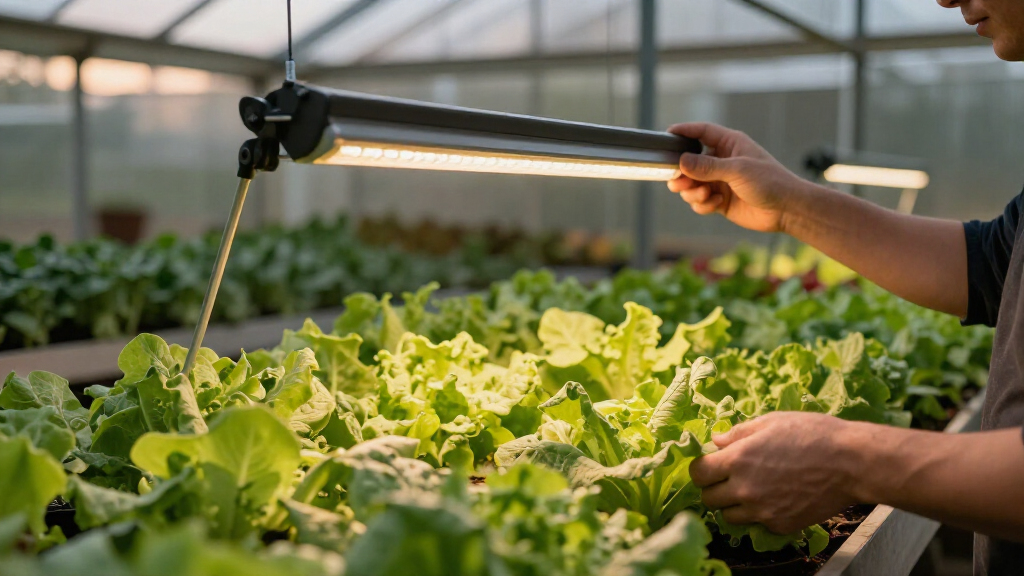
greenhouse LED grow lights adjustable spectrum two channel
As an affiliate, we earn on qualifying purchases.
As an affiliate, we earn on qualifying purchases.
From Fixture Specs to Crop Data
The report places the current shift within a period of rapid change in controlled-environment agriculture. Growers are being asked to weigh fixture performance alongside energy use, crop response, operational flexibility and long-term costs. It does not identify one standard system that fits all greenhouses; the recommendations differ according to crop type, sunlight exposure and reliance on supplemental LEDs.
That distinction also shapes expectations for automation. TotalGrow Lights director of lighting science and product Jeff Mastin says produce monocrop operations that depend heavily on LEDs may benefit more from adaptive systems than ornamental operations with many varieties and substantial natural sunlight. The report presents this as his assessment, not as a measured comparison across greenhouse businesses.
Potential inputs for future systems include environmental sensors, cameras that track plant size and color, chlorophyll fluorescence sensors and, Mastin says, plant electrical signals. Tremblay expects software to use sunlight, weather forecasts, electricity prices and crop stage to adjust lighting. These ideas are presented as possible directions, rather than as evidence that all such systems are already widely deployed.
“If you don’t have enough light being generated and delivered to your plants, they will not meet your growth and quality goals.”
— Jeff Mastin, director of lighting science and product at TotalGrow Lights
Automation Still Has Limits
The report does not provide independent performance data comparing the systems or methods discussed, nor does it quantify potential energy savings, yield gains or payback periods. It also does not specify how widely adaptive lighting or AI-based controls are currently used across greenhouses.
Whether AI can make dependable production decisions remains unresolved. Mastin says crop responses are influenced by multiple variables and warns against automating adjustments prematurely. The sources anticipate roles for alerts, data and recommendations in the nearer term, but the report does not establish a timeline for broader deployment or describe a validated system that can safely manage lighting across different crops and growing conditions.
Measure Before Automating
The report’s practical next step for growers is to measure light where crops grow, track daily light integral across benches during winter and use the results to compare system bids. Suppliers’ guidance also points to reviewing installed cost, expected electricity and maintenance costs, crop-specific spectrum, control compatibility and provider support before a purchase.
Over the coming years, greenhouse operators and technology suppliers will continue testing how sensors and software can make supplemental lighting respond to changing sunlight, forecasts, energy prices and crop stages. The pace and reliability of that shift are not yet established. For now, the report’s sources describe data and recommendations as more appropriate near-term uses than handing production decisions fully to automated systems.
Key Questions
What should growers measure before choosing a new lighting system?
Growers should measure light at crop-canopy height and track daily light integral across their growing area, including bench-to-bench variation. Tremblay recommends collecting measurements through a full winter to understand how natural sunlight and supplemental lighting combine.
How should growers compare greenhouse lighting costs?
The report’s sources recommend looking beyond fixture purchase price. Compare installed cost per micromole delivered, energy use, maintenance, expected service life, control integration and supplier support. Hanan describes lighting as a 10- to 15-year investment.
Can AI already control greenhouse lighting reliably?
The report does not establish that AI systems can reliably make production decisions across crops and greenhouse conditions. Mastin warns that plant responses have many contributing variables; he sees alerts and recommendations as more suitable near-term roles for the technology.
Does every crop benefit from the same light spectrum?
No single spectrum is presented as suitable for every crop or goal. Tremblay says growers should consider spectrum in relation to their crop list and production aims; he cites blue light for limiting stretch and far-red in photoperiodic lighting to speed flowering in many long-day crops.
Source: rss
Halloween Picks
halloween
As an affiliate, we earn on qualifying purchases.