
TL;DR
Anthropic’s $965 billion valuation signals more than just hype; it highlights a shift where access to massive compute capacity is the real driver of AI growth. This round is as much about infrastructure as it is about valuation, reflecting the race for AI’s future power. It highlights a shift towards hardware-driven AI development.
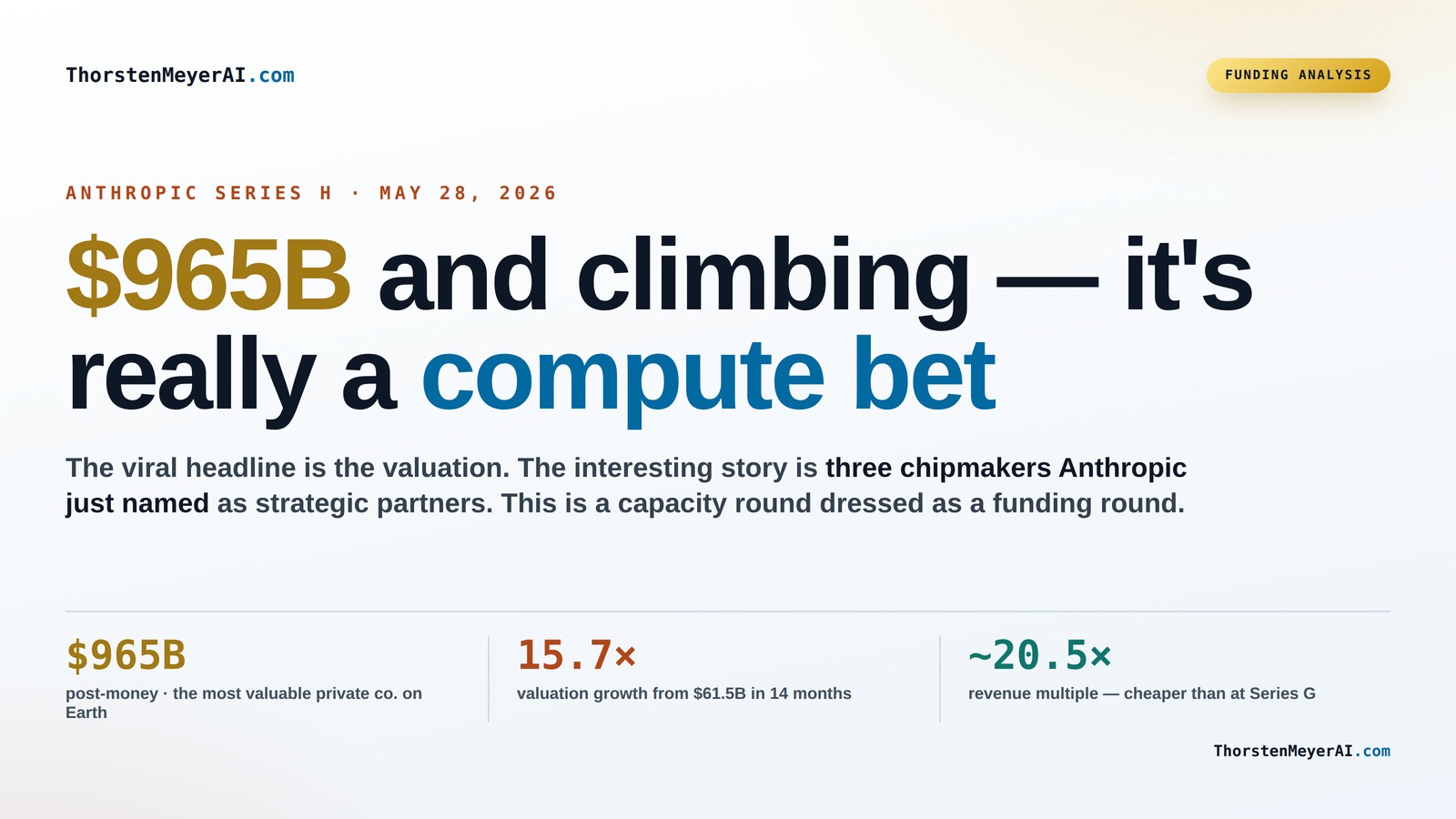
$965B and climbing — it’s really a compute bet
The viral headline is the valuation. The interesting story is in the press release’s middle paragraphs — and in three chipmakers Anthropic just named as strategic partners. This is a capacity round dressed as a funding round.
The numbers nobody can quite parse in sequence
Read together they describe a trajectory with no precedent in enterprise software. Read individually, each looks like a typo.
From $61.5B to $965B in fourteen months
Salesforce took roughly two decades to reach revenue numbers Anthropic just blew past. The sequence below is the part most coverage skips — it’s not the size, it’s the shape.
Anthropic’s valuation ladder · Mar 2025 → May 2026
Five rounds, fourteen months. Bar height is the valuation; the climb itself is the story. Tap any milestone for context.
The multiple actually got cheaper
Bubbles look like multiples expanding while revenue lags. Anthropic’s pattern is the inverse — the valuation tripled, but revenue grew faster, and the multiple compressed.
Revenue-to-valuation multiple · Series G → Series H
Same company, three months apart. The denominator (revenue) is outrunning the numerator (valuation) — exactly the opposite of what a bubble narrative predicts.
10+ gigawatts and three chipmakers
When you name Micron, Samsung & SK hynix alongside your equity backers, you’re saying the binding constraint isn’t demand or model quality — it’s the physical supply of memory chips. The Series H is a capacity round.
Compute commitments backing Anthropic’s capacity bet
$200B+ in announced compute spend across multi-year contracts. The $65B Series H raise has to be read against that bill, not against operating losses.
A genuinely durable bet — or a structural exposure?
Both readings can be true at once. The answer arrives over the next 18–24 months as the gigawatts come online and either fill with paying demand or don’t.
Revenue growth has no precedent in B2B software ($1B → $47B in 17 months). The multiple is compressing, not expanding. Claude is the only frontier model on all 3 major clouds. Enterprise AI spend share went from ~10% to >65% in a year. Compute commitments are tied to specific contracts with capacity dates.
20× revenue is not cheap by any historical software-investing standard. Revenue is reported gross of cloud-reseller pass-throughs, which inflates the top line. Profitability is 2 years out. Amodei’s own warning: a 12-month delay in AI progress “would make him bankrupt” — the compute commitments are a structural exposure to demand persistence.
The valuation race — and the IPO context
Anthropic shipped Opus 4.8 the same morning as Series H — not a coincidence. One week after OpenAI filed confidentially for IPO. The late-2026 frame is set: two frontier AI companies racing to public markets, each pitching durability.
Key Takeaways
- Anthropic’s valuation is driven more by its infrastructure commitments than just revenue — emphasizing the shift towards hardware as the real value in AI.
- Revenue growth at Anthropic is outpacing valuation, signaling sustainable expansion rather than bubble behavior.
- The ‘compute round’ represents a strategic play to secure chips, cloud capacity, and supply chain dominance for future AI growth.
- Major tech giants and chipmakers are now key partners, turning infrastructure into a core competitive advantage.
- Investors are betting on the hardware supply chain as the bottleneck, with billions pouring into chip factories and cloud giants.

Dual Edge TPU PCIe x1 Low Profile Adapter – Coral Accelerator Board for Dual Edge TPU Modules with Mounting Screw
- Compatibility: Designed for dual Edge TPU modules
- Form Factor: Low-profile, space-saving design
- Interface: PCIe x1 connection for reliable transfer
As an affiliate, we earn on qualifying purchases.
As an affiliate, we earn on qualifying purchases.
Why the $965B valuation is just the start—compute is the real story
Anthropic’s latest raise pushes its valuation past $965 billion, making it the most valuable private company ever. But the real kicker? It’s not just about how much money they raised. It’s about what they’re buying — access to a mountain of compute capacity.
Imagine trying to run a high-speed train without tracks. No matter how fast the train is, it won’t go anywhere without the right infrastructure. That’s what this funding round is about — securing the rails for AI’s future. The press release names chipmakers like Micron, Samsung, and SK hynix as strategic partners in building the necessary infrastructure. This isn’t just partnership talk. It’s a signal: these companies are the supply chain, the foundation of AI’s next leap.
Think of it like building a skyscraper. You need the right steel, concrete, and cranes. Here, the ‘steel’ is chips and memory, and the ‘cranes’ are cloud servers. The valuation is a reflection of how much investors believe in this infrastructure-driven future.

How Anthropic’s revenue growth is outpacing its valuation — and why that matters
Anthropic’s revenue isn’t just growing — it’s exploding. Between Series G and H, revenue soared from around $14 billion to over $47 billion annualized. That’s a 5.4x increase in just a few months. For context, most tech companies take years to see this kind of revenue jump.
Picture a small rocket suddenly fueling up with enough fuel to reach orbit. The company’s market value is climbing faster than ever, but here’s the twist: the valuation multiple is actually shrinking.
At Series G, Anthropic was valued at about 27 times its revenue. Today, it’s roughly 20.5 times. This means revenue is catching up with valuation — a sign that investors see real growth, not just hype, behind those numbers.
This pattern flips the usual bubble narrative, where multiples inflate as revenue lags. Instead, Anthropic shows a company growing fast enough to make its valuation look reasonable, even as it becomes the biggest AI startup on Earth.

The strategic dance: chipmakers and cloud giants in the AI race
This isn’t a simple funding round. It’s a strategic dance involving giants like Amazon, Microsoft, Nvidia, and leading chipmakers. This reflects a shared vision for infrastructure dominance. The $65 billion includes commitments from these giants, signaling a shared vision: AI’s future depends on hardware and cloud infrastructure.
For example, Amazon has committed $5 billion, and Microsoft continues its strategic partnership. These aren’t just investors; they’re suppliers, collaborators, and infrastructure providers. Think of them as the backbone of AI’s next era.
Compare it to building a car factory: you need the best steel, assembly lines, and engineers. Here, the ‘steel’ is high-speed chips, and the ‘assembly lines’ are cloud data centers. The investments reflect a belief that AI’s power lies in how fast and efficiently you can train and deploy models.
This means the AI race is shifting from just algorithms to who controls the best hardware and infrastructure.

The economics of AI: why infrastructure costs are the new battleground
Training a giant language model now costs tens of millions of dollars, mainly on compute hardware. The more compute you have, the more data you can process, and the better your models become. But it’s not just about training — inference at scale also demands massive resources.
Consider a typical large model: training might cost $20 million, but running it at scale daily can cost millions more. That’s why companies like Anthropic are pouring billions into GPU farms and memory chips — to keep models running fast and cheap.
Think of it like owning a fleet of super-efficient trucks — the more trucks you have, the more goods you can deliver, and the faster you grow. But trucks aren’t cheap. The same applies to AI hardware: expensive, but vital for staying ahead.
This makes hardware supply chains and cloud capacity the new economic battleground. Whoever controls the infrastructure wins the race for AI dominance.
What does a ‘compute round’ really mean for the AI industry?
A ‘compute round’ means investing in the hardware and infrastructure needed to train, fine-tune, and run massive models. This is a strategic move to secure AI’s future capabilities. It’s like fueling a rocket — with enough fuel, you can go further and faster.
Anthropic’s recent raise isn’t just about money in the bank. It’s about securing a supply chain, cloud capacity, and chip manufacturing — the critical ingredients in AI’s growth engine.
Imagine trying to build a spaceship without enough fuel or a launchpad. That’s the risk today’s AI companies face — without enough compute, even the best models can’t reach their potential.
So, when you see billion-dollar funding rounds, remember: they’re often a strategic move to lock in the infrastructure needed for future AI breakthroughs.