TL;DR

Get garden gear delivered free — and shop member deals
- Fast, free delivery on millions of items
- Access to Prime Big Deal Days deals on October 6–7
- Prime Video, Amazon Music and more included
A Gardener’s Path report recommends four steps to help strawberry plants survive winter: renovate them after harvest, apply fertilizer, keep watering until the first frost and add mulch after the first frost. The timing and amount of care vary by strawberry type, growing conditions and local frost dates.
A Gardener’s Path report outlines four steps for preparing strawberries for winter: renovate the plants, fertilize, water until the first frost and apply mulch after frost arrives. The guidance matters to growers in regions with freezing winters because cold and repeated freeze-thaw cycles can damage crowns, roots and buds needed for the next season’s crop.
The report recommends renovating plants after harvest, but pruning depends on the strawberry type. For June-bearing varieties, it advises cutting foliage to about one to two inches above the crown, thinning plants that have spread, and clearing weeds and debris. The report cautions that mowing a large patch should be done no more than a week after the final harvest, to avoid harming new leaves. Everbearing and day-neutral plants should instead have damaged, diseased or pest-infested leaves removed; the report advises thinning these plants to about five per square foot and removing runners.
For fertilizer, the report cites Richard Jauron, an outreach horticulturist with Iowa State University Extension. Jauron recommends a balanced 10-10-10 fertilizer at five pounds per 100 feet of row, or one pound per 25 plants, at least a month before the average first frost. Granular fertilizer should be kept off foliage and watered in, according to the report. It also says to provide about one inch of supplemental water weekly when rain is lacking, continuing until the first frost.
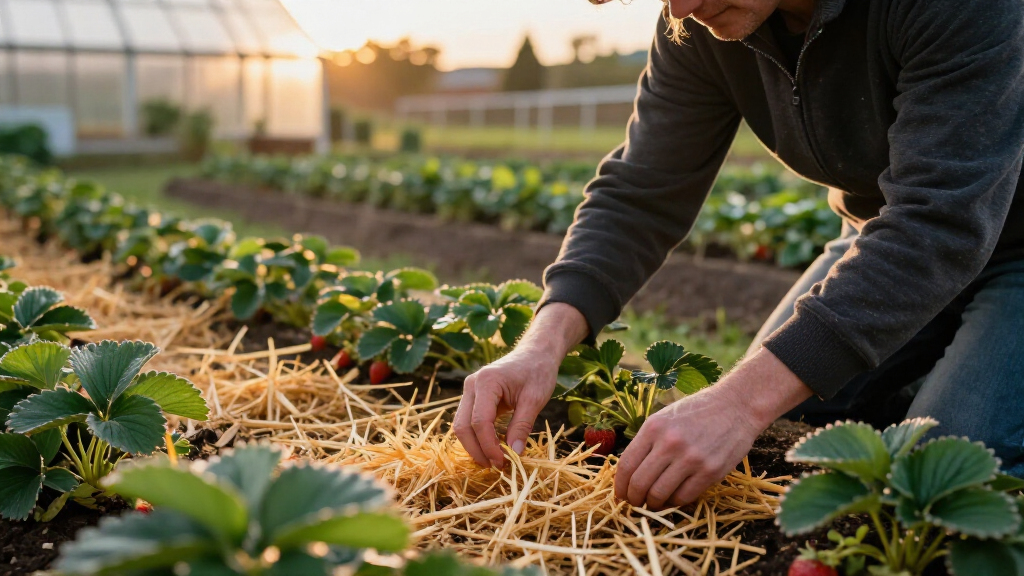
Mulch should be added after the first frost, not while the ground is still warm. The report gives a general window of late November to early December, after foliage has browned and before temperatures fall below 20°F. Because frost dates and temperatures differ by location, that calendar range is not a fixed schedule for every garden. The report says loose mulch can insulate plants, help limit temperature swings and retain moisture around crowns.
Protecting Crowns and Next Season’s Crop
Winter preparation is intended to reduce several risks, not guarantee a harvest. The report says mulch can help keep plants at a more even temperature during freeze-thaw cycles, limit soil movement that can uproot plants, and retain moisture around the crown. These measures may help protect next spring’s buds and roots, particularly where snow cover is limited.
The report cites University of Minnesota Extension horticulturalist Emily Hoover as saying temperatures of 15°F or below can cause fatal crown damage. That warning describes a risk threshold, not a prediction that every plant will die at that temperature; exposure, snow cover, cultivar and growing conditions also matter. For gardeners, the practical point is that correct timing and a protective mulch layer can matter when plants face severe cold.
strawberry plant winter protection mulch
As an affiliate, we earn on qualifying purchases.
As an affiliate, we earn on qualifying purchases.
Care Varies by Strawberry Type
Strawberries are perennial plants that can be grown in USDA Hardiness Zones 3 to 10, according to the source. Some gardeners in colder areas treat them as annuals, but the report says hardy cultivars and winter care can allow plants to return in later seasons. It also notes that many strawberry types need 200 to 300 chill hours—temperatures between 45°F and 32°F—for optimal fruit production. This cold requirement is distinct from protection against damaging extreme temperatures.
The report distinguishes June-bearing, everbearing and day-neutral strawberries. June-bearing plants generally produce one large crop, while everbearing varieties can produce three harvests and day-neutral types may fruit through the growing season when temperatures remain within their stated range. Those differences explain why post-harvest renovation is not identical for every planting. Container-grown plants can receive the same preparation, the report says, and then be moved to a basement, shed or garage; plants in cold storage need only enough water to keep their soil from drying out completely.
“Temperatures of 15°F or below can cause fatal damage to the crown.”
— Emily Hoover, horticulturalist at University of Minnesota Extension, as cited by Gardener’s Path
Local Frost Dates Shape Timing
The report offers general timing rather than a location-specific calendar. It does not identify a reader’s expected first frost, forecast lows, snow cover or strawberry cultivar, all of which can affect when and how much protection is appropriate. Its late-November-to-early-December mulch window should be read alongside the stated temperature cues: after the first frost and before temperatures fall below 20°F.
The source also does not establish that these steps guarantee plants will survive or produce a particular yield. The 15°F crown-damage warning is attributed guidance, and actual outcomes may vary with exposure, plant health, soil moisture and the type of strawberry. No current local weather or extension advisories are provided.
Follow Frost and Plant Conditions
Growers following the report should first identify their strawberry type and finish post-harvest cleanup as directed for that type. They can then apply the cited fertilizer recommendation early enough to meet the one-month-before-average-first-frost timing, keep plants watered when rainfall is insufficient, and wait for the first frost before mulching. Before applying mulch, check local frost dates and near-term temperatures rather than relying only on the report’s calendar range.
For container plants, the report suggests moving prepared pots to a basement, shed or garage and checking the soil during dormancy so it does not dry out completely. The source does not specify a universal mulch depth or a single material for all gardens; gardeners should use locally appropriate guidance for their growing conditions.
Key Questions
When should I mulch strawberry plants for winter?
The report recommends mulching after the first frost, once much of the foliage is brown and floppy, and before temperatures fall below 20°F. Its late-November-to-early-December range is general; local frost and temperature conditions should guide timing.
How much should I prune strawberry plants?
For June-bearing strawberries, the report advises cutting foliage to one to two inches above the crown, with mowing a large patch no more than a week after the final harvest. For everbearing and day-neutral plants, it recommends removing damaged or unhealthy leaves rather than following the same full pruning instruction.
How much fertilizer does the report recommend?
It cites a recommendation for balanced 10-10-10 fertilizer at five pounds per 100 feet of row, or one pound per 25 plants, at least a month before the average first frost. Keep granular fertilizer off foliage and water it in, following the product label.
Should I water strawberries during winter?
In the garden, the report says to water as needed through the first frost, providing about one inch weekly when rain is absent. Dormant garden plants do not need supplemental irrigation during cold months, while container plants in a cold shed or garage need only enough water to keep soil from drying out completely.
Can strawberry plants survive temperatures below 15°F?
The source cites an extension horticulturalist’s warning that temperatures of 15°F or below can cause fatal crown damage. It does not say every plant will be damaged at that temperature; protection, snow cover, cultivar and local conditions can affect the outcome.
Source: rss
Fall yard work Picks
leaf blowers
As an affiliate, we earn on qualifying purchases.