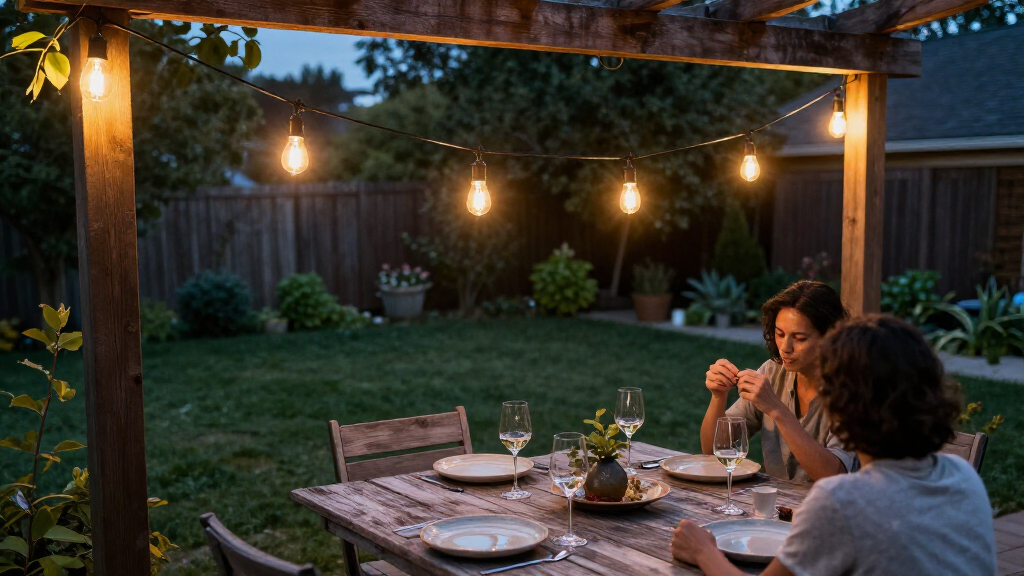

Almost every backyard lighting project starts with the same search: outdoor string lights, thousands of results, prices ranging from $15 to $150 for what looks like the same product. The strands look nearly identical in photos — warm bulbs on a wire, cozy patio glow — so the natural assumption is that the cheap ones are the same product without the brand markup. Sometimes that is true. Usually it is not. The real decision is between budget LED strands sold in bulk boxes and commercial-grade patio lights of the type used by restaurants and event venues. The difference is not brightness or aesthetics; it is what happens after six months of rain, sun, and wind. This comparison breaks down where the two categories genuinely differ, where they do not, and who should buy which.

Get garden gear delivered free with Prime
- Fast, free delivery on millions of items
- Prime Video, Amazon Music and more included
- Member-only deals all year

SUNTHIN 105FT Outdoor String Lights with 34 1W LED Bulbs
- ✔ Length: 105 feet
- ✔ Bulbs: 33 S14 LED, E26 base
- ✔ Color Temperature: 2700K warm white

NS 100FT LED Construction String Lights, 150W Industrial Grade
- ✔ Length: 100 feet
- ✔ Bulbs: 10 caged LED
- ✔ Brightness: 15,000 lumens total

Tenmiro 200FT Outdoor LED String Lights with Shatterproof S11 Edison Bulbs
- ✔ Length: 200 feet
- ✔ Bulbs: 60 S11 LED Edison (+2 spares)
- ✔ Color Temperature: 2700K warm white
At a Glance
| Criteria | Budget LED string lights ($15–40 per strand) | Commercial-grade outdoor string lights ($60–150 per strand) | Winner |
|---|---|---|---|
| Upfront cost per covered area | $15–40 per strand; full patio often under $80 | $60–150 per strand; full patio often $150–350 | A |
| Weather resistance and lifespan | IP44 or unmarked; 1–2 seasons typical before failures | IP65 rated pro-grade; designed for permanent outdoor installation, 5+ years | B |
| Brightness and light quality | LED, warm white; inconsistent color between strands | Consistent warm white; dimmable on most models | B |
| Repairability and bulb replacement | Bulbs usually non-replaceable; one failure can kill the strand | Replaceable sockets and bulbs; strand keeps working | B |
| Connectability and run length | 2–3 strands end-to-end; thin 20–22 AWG wire | 6–10+ strands connectable; heavy 16–18 AWG wire | B |
| Safety and wiring quality | Minimal strain relief, thin insulation, basic plugs | Proper strain relief, UV-resistant jackets, fuse-protected plugs | B |
| Aesthetics and bulb options | Limited sizes; mostly plastic bulbs | Wide range of bulb shapes (G50, ST58, edison styles), glass options | B |
SUNTHIN 105FT Outdoor String Lights with 34 1W LED Bulbs
For most people shopping for outdoor string lights, the brief is simple: warm, inviting light that survives the weather and stretches far enough to look intentional. The SUNTHIN 105FT nails that brief better than either competitor here. Its 33 S14 LED bulbs emit a 2700K warm amber glow that reads as classic café-string ambience — exactly the mood the Tenmiro also targets, but the SUNTHIN offers something the Tenmiro doesn’t: dimmability. Paired with a compatible dimmer, you can drop from full evening brightness to a low, dinner-party shimmer, effectively getting multiple products in one strand.Where this option stands out against both rivals is layout flexibility. With up to 10 connectable strands, you can scale from a small balcony run to a full backyard canopy without cutting or splicing. The Tenmiro solves length differently — one giant 200-foot strand — which is great for a single long run but far less adaptable when your space is L-shaped or split across zones. The tradeoff for that modularity is wattage: 33 watts per strand adds up as you connect more, so plan your outlet capacity if you’re going big.Build quality is reassuring rather than premium. The shatterproof plastic bulbs are IP65 waterproof and safe for rain, snow, and roughhousing kids — a genuine advantage over glass Edison bulbs that shatter into hazards. The compromise is aesthetic: plastic doesn’t catch the light quite like glass, so design purists may find it slightly less charming. And the biggest annoyance is that the dimmer is sold separately, which feels like an upsell on an otherwise complete package. Compared with the NS, this strand is dramatically dimmer — but that’s the point; nobody hangs café lights to read blueprints by.
Pros:
- Shatterproof plastic bulbs are safe around children and pets
- IP65 waterproofing holds up through rain and snow
- Up to 10 connectable strands allow custom layouts
- Dimmable output lets you shift from functional to mood lighting
Cons:
- Dimmer must be purchased separately
- Connected strands draw meaningful wattage at scale
Best for: Homeowners who want warm, dimmable patio or backyard ambience with modular, expandable coverage.
Not ideal for: Anyone who needs bright task lighting, or buyers unwilling to purchase a separate dimmer.
Bottom line: The most balanced pick of the three: warm, safe, expandable, and dimmable — if you accept the accessory upsell.
“The most balanced pick of the three: warm, safe, expandable, and dimmable — if you accept the accessory upsell.”
NS 100FT LED Construction String Lights, 150W Industrial Grade
It says something about how different these products are that the NS barely belongs in the same sentence as the other two. Where the SUNTHIN produces gentle ambience, the NS produces 15,000 lumens of 5000K daylight — enough to illuminate a job site, a two-car garage, or a dim workshop as effectively as overhead fixtures. Each of its 10 caged bulbs pushes 1,500 lumens with a CRI above 80, rendering colors faithfully enough for paint matching and detailed work. If your "outdoor string lights" need to help you finish the fence at 9pm rather than admire it, this is the strand.The engineering reflects its industrial brief. IK07 impact resistance and protective bulb cages mean dropped tools and swinging ladders won’t end the party, and the strand tolerates -22°F to 140°F — a wider operating window than typical consumer strands. Its 100V–277V compatibility and daisy-chaining of up to 5 sets (110–120V) or 10 sets (220–240V) make it genuinely jobsite-friendly, and the 5-year warranty and 50,000-hour LED lifespan dwarf the SUNTHIN’s single year of coverage. ETL certification rounds out a spec sheet built for contractors.The drawbacks are predictable but real. This is harsh, utilitarian light — hung over a patio dinner, it will feel like eating in a warehouse. It requires AC power, so remote corners of a property are off limits, and despite the rugged rating, the housing is plastic rather than metal, which gives us pause about long-term abuse on rough sites. Compared with the Tenmiro, you get a fraction of the length and none of the charm; compared with the SUNTHIN, none of the warmth or dimming. But for its actual audience, nothing else here comes close.
Pros:
- 15,000 lumen output with balanced, glare-reducing distribution
- IP65 waterproofing plus IK07 impact resistance with bulb cages
- 100V–277V compatibility with daisy-chaining of 5–10 sets
- ETL certified, 50,000-hour lifespan, and 5-year warranty
Cons:
- Plastic housing may not survive heavy jobsite abuse like metal builds
- Requires an AC power source, limiting remote placement
- 5000K daylight output is unflattering for entertaining spaces
Best for: Contractors, DIYers, and anyone lighting a garage, workshop, or construction zone.
Not ideal for: Anyone shopping for decorative patio or garden ambience.
Bottom line: A purpose-built work light, not a decoration — unbeatable on job sites, misplaced over a dinner table.
“A purpose-built work light, not a decoration — unbeatable on job sites, misplaced over a dinner table.”
Tenmiro 200FT Outdoor LED String Lights with Shatterproof S11 Edison Bulbs
Some outdoor spaces defeat ordinary string lights. A long fence line, a spacious yard, a pergola-to-shed run — these demand either multiple linked strands or, better, one that simply goes the distance. The Tenmiro 200FT takes the second approach, and that single decision defines its appeal. By comparison, covering the same span with the SUNTHIN would take two strands plus connection planning; the Tenmiro is unbox, hang, done. For buyers whose biggest frustration with string lights has been splicing and joining strands mid-project, that simplicity is worth a lot.The 60 S11 Edison bulbs (with two spares in the box — a small touch we genuinely appreciate) emit the same 2700K warm white as the SUNTHIN, so the mood is comparable: soft, golden, and flattering for evening gatherings. Where it falls behind the SUNTHIN is control. There’s no dimming support mentioned, and no way to adjust the output — you get warm white, full stop. Buyers who want to fine-tune ambiance will find the SUNTHIN’s dimmer ecosystem (even sold separately) the smarter long-term investment.Build-wise, the shatterproof plastic bulbs and waterproofing make it a genuine year-round option, and the 365-day replacement warranty is more generous than the SUNTHIN’s. The honest critique is aesthetic: plastic S11 bulbs at this scale can read slightly utilitarian, lacking the refractive sparkle of glass Edison bulbs — noticeable on a 200-foot run that’s meant to be a design statement. And unlike the NS, this is purely decorative light; don’t expect to navigate a workbench under it. Still, for big-space coverage with one strand and one plug, nothing else in this lineup competes.
Pros:
- 200ft single-strand coverage eliminates joins and splices
- 60 shatterproof bulbs plus 2 spares included
- Fully waterproof for year-round outdoor use
- 365-day warranty with free replacement
Cons:
- Plastic bulbs look less premium than glass Edison options
- Fixed 2700K output with no dimming or color options
- Excessive length for small spaces
Best for: Owners of large yards, long fences, or expansive patios who want one continuous strand without splicing.
Not ideal for: Buyers who want dimming or color control, or those lighting small balconies (the length is overkill).
Bottom line: The easiest way to light a big yard — trade adjustability for scale and you have a winner.
“The easiest way to light a big yard — trade adjustability for scale and you have a winner.”
As an Amazon Associate we earn from qualifying purchases.
Key Differences
The gap that actually matters is durability and repairability. Budget strands typically carry an IP44 rating at best, sometimes no rating at all, which means they handle light rain but degrade quickly under sustained UV exposure, snow load, or moisture in the sockets. The common failure pattern is well documented by anyone who has owned them: one bulb or one section dies within a season or two, the bulbs cannot be replaced because they are soldered in, and the whole strand becomes trash. Commercial strands use IP65-rated sealed sockets, replaceable bulbs in standard bases, and UV-resistant cable jackets, which is why restaurants leave them up permanently for years.
The second meaningful difference is electrical. Commercial strands use thicker wire (16–18 AWG vs 20–22 AWG on cheap strands) and support connecting six to ten strands end-to-end on one outlet. Budget strands usually cap out at two or three connected strands, which forces extension cords and multiple outlet runs on anything larger than a small balcony. On a big deck or a pergola over 40 feet, this is often the deciding factor on its own.
Where the gap is smaller than expected: light quality. A good budget warm-white LED strand and a commercial strand are hard to tell apart at night from ten feet away. If your setup is seasonal, sheltered, and small — a covered porch, a balcony — the premium price buys durability you will not use, and the budget strand delivers 90 percent of the visual result.
Detailed Comparison
Upfront cost per covered area (Budget LED string lights ($15–40 per strand) wins — major)
Budget strands win on raw cost, and not by a little: covering a typical 20×20-foot patio with a zigzag pattern takes roughly 100 feet of lights, which means about $60–80 in budget strands versus $200–350 in commercial-grade. That is a 3–4x price gap for the same visual footprint. However, the honest cost comparison includes replacement. If budget strands fail every one to two years — which is the norm when left outdoors — a five-year horizon brings their real cost close to or above the commercial option. For a single season or occasional use (parties, holidays, renters), the budget option is decisively cheaper. For a permanent installation you own, the gap narrows sharply.
Weather resistance and lifespan (Commercial-grade outdoor string lights ($60–150 per strand) wins — major)
This is where the categories are genuinely different products, not tiers of the same one. Commercial strands are IP65 rated — protected against water jets and dust — with sealed sockets and UV-stabilized insulation, and they are explicitly marketed for permanent outdoor installation. Budget strands are usually IP44 (splashing water only) or unrated, with plastic that becomes brittle after a summer of direct sun and sockets that corrode in humid climates. The practical consequence: budget strands left up year-round in most climates start failing within 6–18 months, while commercial strands routinely last five years or more hung permanently. If you plan to take lights down every winter and store them, budget strands last considerably longer and the gap shrinks.
Brightness and light quality (Commercial-grade outdoor string lights ($60–150 per strand) wins — minor)
A modest gap that most people cannot see. Both categories are now dominated by warm-white LEDs (2200–2700K), and at typical viewing distance the glow from a $25 strand and a $100 strand looks similar. Commercial strands have tighter color consistency between bulbs and between strands — mixing three budget strands from different batches sometimes produces visibly mismatched tints. Commercial strands are also more consistently dimmable with compatible dimmers, which budget strands often are not. A pleasant difference, not a night-and-day one.
Repairability and bulb replacement (Commercial-grade outdoor string lights ($60–150 per strand) wins — major)
This criterion quietly decides total cost of ownership. Commercial strands use standard replaceable bulbs (typically E26 base) in individual sockets, so a dead bulb is a $1–2 swap and a damaged socket can be re-wired. Budget strands overwhelmingly use integrated, non-replaceable LEDs, meaning a single failure anywhere often kills the entire strand. Practical translation: a commercial setup is a system you maintain; a budget setup is a consumable you replace. Over five years this difference frequently erases the budget option’s price advantage entirely.
Connectability and run length (Commercial-grade outdoor string lights ($60–150 per strand) wins — moderate)
Commercial strands connect 6–10+ units end-to-end safely thanks to heavier-gauge wire; budget strands allow 2–3. On a small balcony this is irrelevant. On a long fence line, a large pergola, or a string of trees, the budget limitation means planning extension cords, hunting for extra outlets, and visible cord clutter. Buyers with spaces over roughly 30–40 linear feet consistently report this as the moment they regret going cheap. Major practical gap for larger spaces, minor for small ones.
Safety and wiring quality (Commercial-grade outdoor string lights ($60–150 per strand) wins — moderate)
Both categories are low-voltage-risk LED products and safe when used as intended, but build quality differs. Commercial strands have proper strain relief at plugs and sockets, fuse protection in the plug, and insulation rated for sustained outdoor UV exposure. Budget strands cut corners here: thin insulation, weak strain relief, and plugs that loosen over time. The realistic risk is not electrocution but fire from overloaded connections and daisy-chained cheap strands — a risk that grows when buyers chain more strands than the wiring supports. If you are running long connected runs, the commercial option’s heavier wiring is not just convenience, it is the safer design.
Aesthetics and bulb options (Commercial-grade outdoor string lights ($60–150 per strand) wins — minor)
Commercial lines offer real glass bulbs in multiple shapes and sizes — edison-style filaments, G50 globes, vintage ST58 — with a depth and sparkle that plastic bulbs do not quite match, especially visible at close range or in daytime when the lights are off. Budget strands are almost entirely plastic, which photographs fine but can look cheap up close on a permanent installation. For a covered patio where the wire is part of the visible decor, glass commercial bulbs are a genuine upgrade; for a backyard strung high across open space, few will notice.
Budget LED string lights ($15–40 per strand): Pros and Cons
Pros:
- 3–4x cheaper upfront for the same coverage
- Warm-white LED glow that looks nearly identical at night
- Lighter and easier to hang temporarily
- Low-risk way to test whether you even like string lighting
- Cheap enough to replace or redecorate freely
Cons:
- Non-replaceable bulbs — one failure can kill the strand
- IP44 or unrated; typically lasts 1–2 seasons outdoors
- Only 2–3 strands connectable; extension cords needed for larger spaces
- Color tint varies between batches and strands
- Thin wire and insulation degrade under UV and weather
Commercial-grade outdoor string lights ($60–150 per strand): Pros and Cons
Pros:
- IP65-rated for permanent outdoor installation; 5+ year lifespan
- Replaceable standard bulbs and repairable sockets
- 6–10+ strands connectable for large runs on one outlet
- Consistent color, dimmable, heavier and safer wiring
- Glass bulb options with genuinely better close-range appearance
Cons:
- 3–4x higher upfront cost
- Heavier wire requires sturdier mounting points and hooks
- Glass bulbs break if swung into or dropped during hanging
- Overkill for sheltered, seasonal, or occasional use
Who Should Choose What
Choose Budget LED string lights ($15–40 per strand) if:
- You rent, or you are not sure string lighting will stick — test cheap first
- Your space is small and sheltered: a balcony, covered porch, or small gazebo
- You only hang lights seasonally and store them in winter
- You are lighting a one-off event, wedding, or party
- Your total run length is under about 30 feet
Choose Commercial-grade outdoor string lights ($60–150 per strand) if:
- You own your home and want lights up permanently with no seasonal take-down
- Your space is large — a big deck, pergola, fence line, or trees — needing 40+ feet
- You live somewhere with harsh weather: heavy rain, snow, humidity, or intense sun
- The lights will be visible up close and you care about glass bulbs and finish quality
- You want to dim the lights or expand the system over time
Skip both if: You have no outdoor outlet and no realistic way to run power — solar string lights are a separate category worth considering instead, accepting their weaker, weather-dependent output.
Value for Money
Is paying 3–4x more worth it? Only when durability is actually used. If lights stay up year-round in real weather, the commercial option is better value despite the price: replaceable bulbs and a 5+ year lifespan mean the per-year cost is often lower than repeatedly buying budget strands, and you stop re-hanging lights every spring. If lights go up for a season and come down, or live on a sheltered balcony, the premium buys lifespan you will never collect, and the budget strand delivers nearly the same visual result for a quarter of the money. The value question is not ‘which is better made’ — commercial wins that clearly — it is ‘will this installation survive long enough to pay back the difference.’
Final Verdict
For homeowners installing permanent lighting on a deck, pergola, or yard larger than a small patio, buy commercial-grade. The replaceable bulbs, IP65 weatherproofing, and long connectable runs are not luxuries; they are the features that determine whether the setup still works in three years, and they usually erase the price gap over time. For renters, small sheltered spaces, seasonal use, or anyone unsure they want string lighting at all, budget LED strands are the smarter buy — paying commercial prices for a balcony setup you take down each fall is wasted money. The single deciding factor is installation permanence: year-round outdoor use, go commercial; temporary or sheltered use, go budget and expect to replace rather than repair.
Frequently Asked Questions
How long do cheap outdoor string lights actually last?
Left outdoors year-round, most budget strands start failing within 6–18 months — typically a dead bulb, a corroded socket, or UV-brittle wire. Taken down and stored seasonally, the same strands commonly last 2–4 years. The non-replaceable bulbs mean any single failure usually ends the strand’s useful life.
Are commercial-grade string lights really worth the extra money?
Yes, but only for permanent installations exposed to weather. The replaceable bulbs and IP65 rating give a 5+ year service life, which often makes the per-year cost lower than replacing budget strands repeatedly. For sheltered, seasonal, or occasional use, the premium buys durability you will never use.
Can I connect multiple budget strands together for a large patio?
Usually only 2–3 strands end-to-end — check the manual, as exceeding the rating risks overheating the thin wiring. Larger spaces will need multiple outlet runs and extension cords, which is a common reason buyers upgrade to commercial strands that support 6–10+ connected lengths.
Do string light brightness and color differ between cheap and commercial strands?
Barely. Both are mostly warm-white LEDs and look similar at night. Commercial strands have more consistent color between bulbs and strands, and are usually dimmable; budget strands can show tint mismatch when you mix batches. This is a minor difference, not a reason to upgrade on its own.
Can I leave outdoor string lights up in winter?
Commercial IP65-rated strands are designed for it and handle snow and freezing temperatures when the wiring is intact. Budget IP44 strands survive a mild winter but degrade fast; if you own cheap strands, taking them down from first frost to spring is the best way to stretch their lifespan.
Fall Picks
fall essentials
As an affiliate, we earn on qualifying purchases.