
TL;DR

Get garden gear delivered free with Prime
- Fast, free delivery on millions of items
- Prime Video, Amazon Music and more included
- Member-only deals all year
A Planet Natural report says cutting a lawn very short in one final fall mow can remove too much green leaf tissue and add stress as growth slows. It recommends following the one-third rule, tailoring mowing height to grass and local conditions, and managing thick leaf cover rather than scalping to prepare for winter.
Planet Natural advises homeowners not to scalp their lawns in a single final mow before winter, saying a severe cut can remove too much green tissue just as grass growth slows. The report recommends mowing gradually, following the one-third rule and deciding when to stop based on active growth and local conditions rather than a fixed calendar date.
Scalping means cutting off a large share of the grass blade at once. According to the report, that removes leaf area the plant uses to produce carbohydrates and can leave turf less able to recover from drought, foot traffic or cold. A lawn kept at about 3 inches, for example, should not be cut down to 1 inch in one pass simply because winter is approaching.
The report recommends removing no more than one-third of the blade at each mowing. If a rainy stretch leaves grass unusually tall, homeowners can raise the mower deck for one cut and mow again after a few days, weather and growth permitting. The source says cool-season lawns are commonly maintained around 2½ to 3½ inches, but the suitable height depends on the grass species and site; warm-season grasses follow different patterns as they approach dormancy.
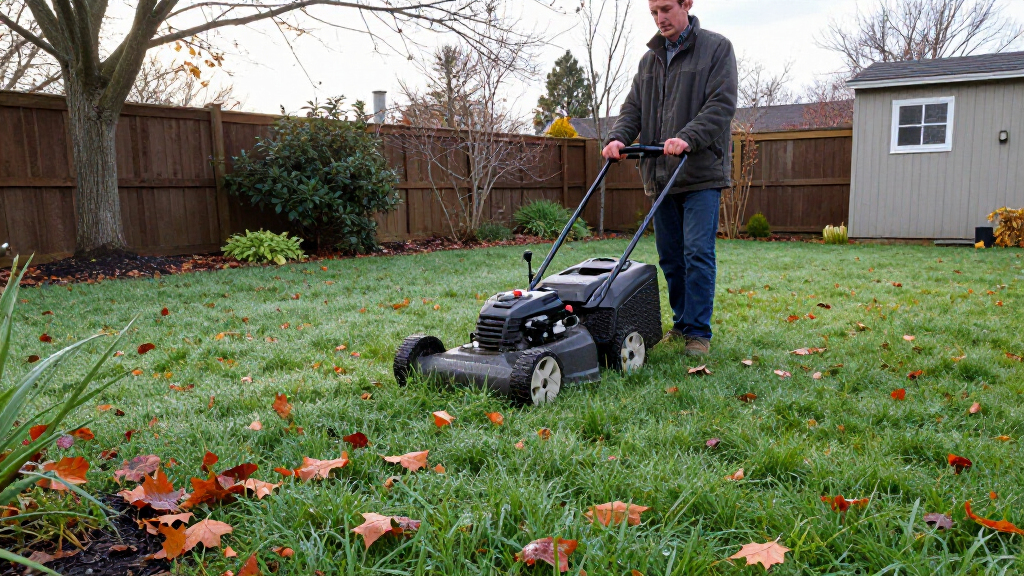
Leaves also need attention, but a short cut is not a substitute for clearing a thick layer. A light covering of dry leaves can be finely mulched into actively growing grass, the report says. Thick, wet leaves can block light and mat turf, so excess material should be mulched over multiple passes, raked for compost or removed. Mowing on dry grass with a sharp blade can help produce a cleaner cut.
How Fall Cuts Affect Winter Turf
The advice matters because the final mowing can affect the condition of a lawn going into its dormant period and its ability to resume growth later. Removing too much leaf area at once adds stress when grass is already slowing down, while leaving a heavy layer of wet leaves can also harm turf by blocking light and holding moisture.
The report cautions against treating one mowing height as a cure for winter problems. In areas with persistent snow cover and a history of snow mold, keeping grass from entering winter excessively tall may be one part of prevention, but mowing height alone cannot solve snow mold. The source also points to thatch, drainage, shade and heavy debris as factors to address.
For homeowners, the practical takeaway is to respond to the lawn in front of them rather than pursue a uniformly short appearance. Gradual cuts and appropriate leaf management can avoid combining two sources of stress: a scalped lawn and a thick leaf mat.
As an affiliate, we earn on qualifying purchases.
Why There Is No Single Winter Height
The Planet Natural report says the right mowing height varies with grass type, climate, shade and snow cover, as well as past disease issues. Kentucky bluegrass, tall fescue, ryegrass and fine fescues have differing preferred ranges, while warm-season grasses may be approaching dormancy earlier. It advises using a local recommendation or identifying the turf before making a major height change.
Timing also depends on growth. The report says to keep mowing as needed while the lawn is actively growing and stop when it no longer reaches the mowing threshold. In many cool-season lawns, that can mean several cuts after summer heat eases; warm-season lawns may have their last cut earlier as dormancy begins. The source gives no universal final-mow date or height.
Local Conditions Shape the Advice
The source does not give one recommended winter height for all lawns, and the guidance cannot determine the right setting for a particular yard without knowing its grass species, regional climate and site conditions. It also does not specify a single date for the last mow. Homeowners with persistent snow cover, a history of snow mold or uncertainty about their turf may need locally tailored guidance.
The report describes possible effects of scalping and leaf buildup as general lawn-care guidance; it does not provide trial data or quantify how much a severe cut changes winter damage or spring recovery. Weather can also limit the chance to make multiple gradual cuts. In that case, the source advises against a panic scalp, but the exact best action will depend on the lawn and conditions.
Watch Growth and Prepare the Mower
As fall continues, homeowners can keep mowing while grass is growing, avoid removing more than one-third of the blade per cut and check whether leaf cover is becoming thick or wet. When growth has stopped, the report says to stop mowing rather than cut frozen, wet or dormant turf merely to make it look uniform.
After the season’s last use, the report recommends cleaning clippings from the mower deck, inspecting and sharpening or replacing a damaged blade, and following the manufacturer’s instructions for safe cleaning and storage. For a gas mower, it says to disconnect the spark plug or use the manufacturer’s safety procedure before cleaning underneath; fuel and batteries should be handled according to the equipment maker’s guidance. The next mowing decision should follow spring growth and local conditions, not a need to compensate for a severe cut in fall.
Key Questions
Why can scalping a lawn before winter be harmful?
According to the Planet Natural report, a severe cut removes too much green leaf tissue at once. That reduces the grass’s ability to produce carbohydrates and can add stress as growth slows.
How much grass should I remove in one mowing?
The report recommends the one-third rule: remove no more than one-third of the current blade at a time. If the lawn is unusually tall, make gradual cuts rather than dropping the mower deck sharply.
What height should I leave my lawn for winter?
There is no single height for every lawn. The report says the appropriate setting depends on grass type, climate and site conditions; it cites about 2½ to 3½ inches as a common range for cool-season lawns, not a universal rule.
Can I mulch leaves into the lawn?
Light, dry leaves can often be mulched finely into actively growing turf. Thick or wet layers should be reduced, raked for compost or removed because they can block light and mat the grass.
When should I make the final mow?
The report says to stop when the lawn has stopped growing enough to reach the mowing threshold, rather than relying on a particular date. Avoid mowing frozen, wet or dormant turf just to make it look even.
Source: rss
Halloween Picks
halloween
As an affiliate, we earn on qualifying purchases.