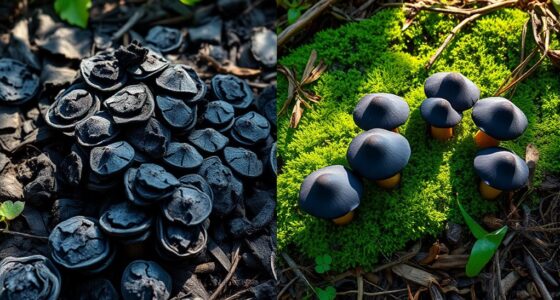
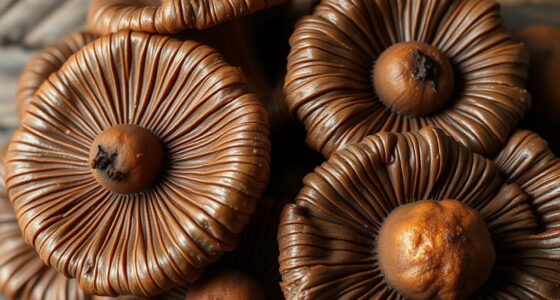
To tell Turkey Tail from its false counterpart, look for vibrant, multi-colored concentric rings and soft, rounded edges—true Turkey Tail has a colorful fan-like appearance. Check its tiny, dense pores underneath; it’s thin, flexible, and easy to peel. False Turkey Tail appears duller, with rough, leathery surfaces and less vibrant colors, often feeling tougher or more rigid. Want to learn more ways to confidently distinguish these fungi? Keep exploring for detailed tips.
Key Takeaways
- Genuine Turkey Tail features vibrant, multi-colored concentric rings, while False Turkey Tail has duller, more uniform coloration.
- Turkey Tail has soft, slightly rounded edges; False Turkey Tail appears leathery or rough with a dull surface.
- Look for tiny, densely packed pores underneath; False Turkey Tail may have different pore or gill structures.
- Turkey Tail is thin, flexible, and easy to peel; False Turkey Tail tends to be thicker, tougher, or more rigid.
- Proper identification ensures safety and medicinal efficacy by focusing on color, texture, and pore characteristics.
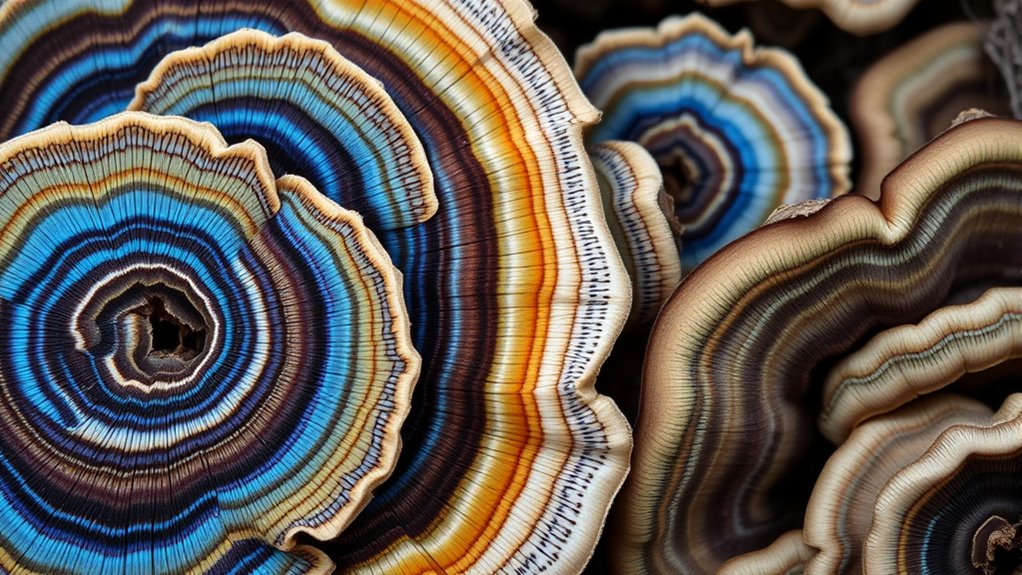
When identifying mushrooms, it’s important to distinguish between Turkey Tail and False Turkey Tail because they look quite similar but have different properties and uses. Your journey toward understanding and harnessing the power of these fungi begins with careful observation and knowledge of their unique features. Turkey Tail, scientifically known as Trametes versicolor, has been celebrated for centuries for its medicinal properties, especially in supporting immune health. Conversely, False Turkey Tail, often mistaken for the real deal, can be misleading and, in some cases, even harmful if misidentified. So, your first step is mastering identification techniques to tell them apart confidently.
Start by examining the surface and color. Genuine Turkey Tail displays a vibrant, multi-colored appearance with concentric rings of browns, reds, and blues, often resembling a colorful fan or tail. The edges tend to be soft and slightly rounded. In contrast, False Turkey Tail usually has duller, more uniform coloration, often lacking the striking bands that characterize the true variety. Its surface may look more leathery or rough, and the colors tend to be muted or faded compared to the vibrant display of Turkey Tail.
Next, focus on the underside. Turkey Tail has tiny, densely packed pores instead of gills, which are critical for identification. These pores are usually small and round, and their arrangement can be seen with a magnifying glass. False Turkey Tail tends to have a different pore structure or may even display gills rather than pores, which is a key distinction. Pay attention to texture as well—Turkey Tail tends to be thin, flexible, and easy to peel, making it easier to harvest sustainably. False Turkey Tail might feel thicker, tougher, or more rigid, and can be less pliable.
Understanding the medicinal properties of Turkey Tail is essential for anyone seeking to unlock its benefits. Known for its immune-boosting compounds, such as polysaccharide-K (PSK) and polysaccharide-peptide (PSP), Turkey Tail has a long history of supporting health and recovery. Proper identification techniques guarantee you’re harvesting the right mushroom, so you can confidently incorporate it into your wellness practices. Additionally, the presence of specific physical features, such as reliable identification methods, is crucial to ensure safety and efficacy. Misidentification can lead to ineffective results or potential risks, so take your time to observe, compare, and verify.

Turkey Tail Mushroom Supplement (120 Capsules – 2 Month Supply) (Coriolus Versicolor) Comprehensive Immune System Support, Non-GMO, Gluten Free, Grown and Encapsulated in The USA by Double Wood
- Immune System Support: Supports immune health in humans and animals
- Powerful Antioxidant: Rich in phenols and flavonoids antioxidants
- Aids Digestion: Contains prebiotics to support digestion
As an affiliate, we earn on qualifying purchases.
As an affiliate, we earn on qualifying purchases.
Frequently Asked Questions
Are There Any Health Risks Associated With Misidentifying These Mushrooms?
Yes, misidentifying mushrooms can pose health risks due to mushroom toxicity. If you mistake false turkey tail for true turkey tail, you might consume toxins that cause illness or worse. Foraging safety is essential—always double-check your identification and avoid wild mushrooms unless you’re an expert. The risks are real, so prioritize safety to prevent accidental poisoning and enjoy your mushroom adventures with peace of mind.
Can False Turkey Tail Mushrooms Be Used in Traditional Medicine?
False turkey tail mushrooms aren’t used in traditional medicine because they lack the medicinal properties found in true turkey tail. While true turkey tail offers health benefits and can be used in herbal remedies, false varieties don’t have proven medicinal uses and are mainly considered inedible or potentially harmful. If you’re seeking medicinal benefits or culinary uses, stick to authentic turkey tail to guarantee safety and effectiveness.
How Long Does It Take to Distinguish Between the Two in the Wild?
It typically takes just a few seconds to distinguish between Turkey Tail and False Turkey Tail in the wild, especially if you’re familiar with mushroom growth patterns and seasonal changes. As you observe, note the color variations and texture differences that become evident during specific seasons. With practice, you’ll quickly identify the true Turkey Tail, allowing you to confidently harvest or avoid false ones, embracing your freedom to forage responsibly.
Are There Any Look-Alike Species That Are Even More Dangerous?
You need to know that look-alike species, especially some toxic mushrooms, can be incredibly dangerous—more treacherous than you imagine. Certain toxic mushrooms mimic safe varieties, but their poisons can cause severe illness or death. Stay vigilant and don’t trust appearances alone. Always double-check with a reliable guide or expert. Your freedom to forage safely depends on recognizing these deadly look-alikes, because one wrong identification could turn your adventure into a nightmare.
What Tools or Resources Are Best for Mushroom Identification?
You should rely on mycology guides and identification apps to confidently identify mushrooms. These tools provide detailed images and descriptions, helping you distinguish Turkey Tail from false varieties and other look-alikes. Use them to learn key features and stay safe. Gathering knowledge empowers you to explore freely, knowing you can identify mushrooms accurately. Always double-check with multiple resources before foraging, so you can enjoy mushroom hunting without unnecessary risks.
Conclusion
Now that you know the differences, spotting Turkey Tail from its false twin is like finding a needle in a haystack. Pay attention to the color, shape, and texture—these clues are your compass. With a little practice, you’ll be able to tell them apart as easily as reading a map. Remember, nature’s little secrets are waiting to be uncovered—so go ahead, explore with confidence and let your curiosity be your guide!