
TL;DR

Get garden gear delivered free with Prime
- Fast, free delivery on millions of items
- Prime Video, Amazon Music and more included
- Member-only deals all year
Crocuses are cold-hardy flowers that need a winter chilling period to bloom; snow can help insulate their corms rather than harm them. The gardening report says snow crocus and Dutch crocus can grow in USDA Zones 3 to 8, with deeper planting suggested for the coldest zones. Corms should be planted in fall, not in winter.
Crocuses can grow in cold climates and bloom through snow, according to a Gardener’s Path report, because their corms need months of winter chilling to flower. The report says snow crocus (Crocus chrysanthus) and Dutch crocus (C. vernus) are suited to USDA Hardiness Zones 3 to 8, and that snow can help insulate corms in the ground rather than damage them.
The report says most crocus corms should be planted six to eight weeks before the first frost, giving them time to establish before winter. It describes crocuses as needing sunlight, well-drained soil and a cold period. Without sufficient chilling, the plants may still grow, but their leaves and flowers can be weak or stunted.
According to the report, corms need about four months in soil at 35°F or below to complete the cold period associated with spring flowering. The article says crocuses can withstand temperatures well below that threshold while dormant. For gardeners in Zones 3 and 4, it recommends planting corms four inches deep rather than three to give them more insulation.
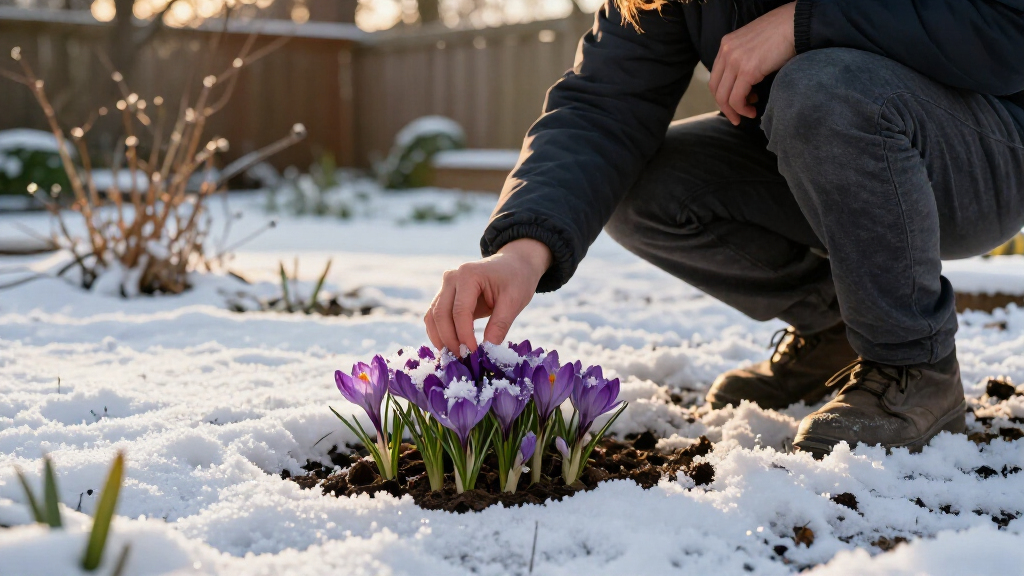
The report says winter planting is not recommended: corms need time in the ground to develop and experience the cold period before flowering. It also describes snow as a protective cover that helps keep corms from drying out. Crocuses may push flowers through late-winter snow, although the exact timing depends on conditions at the planting site.
Winter Cold Supports Spring Blooms
The cold requirement is useful for gardeners planning spring color in regions with harsh winters. Rather than being a threat by itself, winter cold is part of the crocus’s seasonal cycle; the chilling period helps prepare the corm to flower when conditions become favorable. That means a snowy garden is not automatically unsuitable for these plants.
The guidance also distinguishes between cold and other growing conditions. The report identifies sunlight and well-drained soil as requirements alongside cold tolerance. Gardeners who plant in very cold zones can use greater depth to insulate corms, but the article does not suggest that cold hardiness removes the need to choose an appropriate, well-drained planting site.
For readers, the practical takeaway is about timing: planting in fall allows corms to settle in before winter, while planting during winter would leave too little time for that preparation. These points may help avoid disappointing or weak blooms, though local weather and site conditions can affect results.
Popular right now

De'Longhi Dinamica Plus Fully Automatic Espresso Machine

Vitamix Propel Series 510 Professional-Grade Blender, 3 Programs, Black

Apple AirPods Pro 3 Wireless Earbuds with Active Noise Cancellation
As an affiliate, we earn on qualifying purchases.
How Crocus Corms Use Winter
The source report explains the cold requirement through the crocus’s yearly cycle. After summer dormancy, falling soil temperatures prompt the corm to resume growth, producing roots and shoots. When temperatures drop further, the plant enters a winter rest period. The article cites a 2015 paper by Helmut Kerndorff, Erich Pasche and Dörte Harpke, published in the Austrian botanical journal Stapfia, in discussing the plant’s development and life cycle.
The report says the corm remains underground through winter, with the surrounding soil helping protect it. It also cites an article from the Netherlands Bulb Council, published in Texas A&M University’s Horticulture Update, for an explanation of how cold affects moisture within the plant. These references provide context for the report’s explanation; the source material does not present them as a new experiment or announcement.
For warmer-climate gardeners, the article says crocuses may also be grown in Zone 9 if corms are refrigerated for at least four months before spring planting. That is a specific alternative described by the source, not a general claim that all varieties or growing conditions will produce the same results.
“The freezing temperatures trigger a biochemical response in the plant that tells it to bloom in the spring.”
— Gardener’s Path report, citing a 2015 paper by Helmut Kerndorff, Erich Pasche and Dörte Harpke
Local Conditions Shape Bloom Timing
The source gives general guidance, but it does not specify how quickly crocuses will bloom in a particular garden or how outcomes vary by cultivar, soil, snow cover or local temperature patterns. Its statement that flowers can appear after favorable temperatures is not a guarantee of a precise bloom date. Local growing conditions remain a factor.
The report also does not provide comparative trial data for the hardiness of individual varieties or quantify how much extra protection four-inch planting provides. Its zone ranges and planting recommendations should be read as gardening guidance from the cited article, not as a guarantee that every corm will survive every winter.
Plan Fall Planting Before Frost
For gardeners following the report’s advice, the next step is to select a sunny spot with well-drained soil and plant corms in fall, generally six to eight weeks before the first frost. In Zones 3 and 4, the article recommends setting them four inches deep. Gardeners in Zone 9 can consider its refrigerator-chilling method, with at least four months of cold before spring planting.
After planting, the corms need time underground to complete their seasonal cycle. Readers should check local conditions and instructions supplied with their chosen corms, since the source does not give a variety-by-variety planting calendar. The next visible milestone is spring growth, but the precise timing will depend on temperatures and the planting site.
Key Questions
Can crocuses survive snow?
According to the Gardener’s Path report, snow can insulate corms and help keep them from drying out. Crocus flowers may also emerge through late-winter snow.
How much cold do crocus corms need?
The report says corms need about four months at 35°F or below for the chilling period associated with flowering. The source does not give a variety-specific breakdown.
When should I plant crocus corms?
The report recommends planting most corms six to eight weeks before the first frost. It says winter planting is too late for corms to establish and complete their preparation before spring.
How deep should crocuses be planted in very cold areas?
For USDA Zones 3 and 4, the report suggests planting corms four inches deep instead of three to provide additional insulation.
Can crocuses grow in a warm climate?
The report says crocuses can be grown in Zone 9 if the corms are refrigerated for at least four months before spring planting. Results may depend on the variety and local conditions.
Source: gardenerspath.com