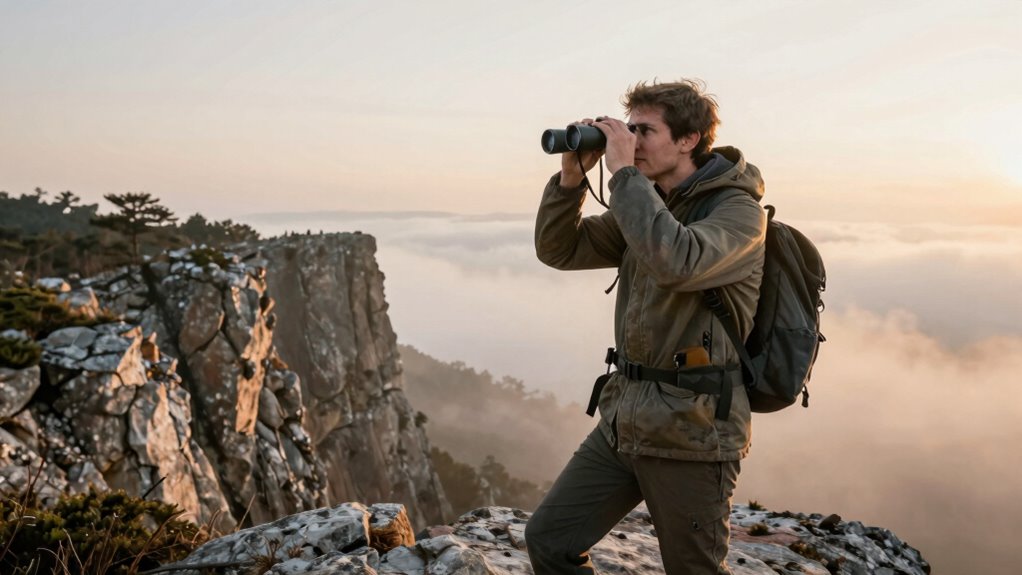

To build a survival mindset around observation, start by practicing deliberate scanning of your environment daily. Notice subtle cues like weather changes, sounds, or behavior of others. Trust your senses and stay calm under pressure. Develop mental resilience through visualization and breathing exercises, which boost your confidence and focus. Over time, your awareness becomes automatic, helping you recognize dangers early. Keep honing these skills, as they form the foundation for quick, effective responses in any situation.

Get garden gear delivered free with Prime
- Fast, free delivery on millions of items
- Prime Video, Amazon Music and more included
- Member-only deals all year
Key Takeaways
- Practice deliberate environment scanning daily to strengthen awareness and recognize subtle cues early.
- Develop mental resilience through visualization and breathing exercises to stay calm and focused.
- Continuously learn about environmental signs and survival strategies to adapt quickly.
- Trust your senses and interpret sensory input confidently to identify potential threats.
- Maintain a habit of constant alertness without panic to enhance decision-making in stressful situations.

Having a survival mindset is essential when facing unpredictable situations, and sharp observation skills are your greatest tools in such moments. Developing this mindset starts with recognizing that emergency preparedness isn’t just about having supplies; it’s about cultivating mental resilience that allows you to stay calm and focused when chaos unfolds. When you actively observe your environment, you gather critical information that can mean the difference between safety and danger. Your ability to notice subtle cues—like changes in weather, nearby sounds, or the behavior of others—gives you an advantage in making quick, informed decisions.
To build this mindset, you need to commit to constant awareness. Practice scanning your surroundings deliberately, noting details that others might overlook. Over time, this habit transforms into an instinct that sharpens your situational awareness. As you become more observant, you’ll start to see patterns and anticipate potential threats before they materialize. This proactive approach to observation enhances your emergency preparedness by enabling you to identify risks early and respond appropriately. It’s about staying alert without succumbing to panic, maintaining mental resilience even in stressful situations.
Furthermore, fostering a survival mindset involves understanding that your mental resilience is just as critical as physical readiness. It’s about training your mind to stay composed, even when circumstances are chaotic. You can strengthen this resilience through mental exercises, such as visualization or breathing techniques, which help keep your mind clear and focused. As your observation skills improve, you develop confidence in your ability to interpret what you see and hear, reinforcing your mental resilience. This confidence reduces fear and anxiety, enabling you to act decisively rather than react impulsively.
Building a survival mindset also means embracing continuous learning. Stay curious about your environment and seek out knowledge about survival strategies. Practice observing deliberately, and challenge yourself to notice new details each day. Over time, this effort becomes second nature, allowing you to adapt quickly to new threats or changes. Your heightened observation, coupled with mental resilience, creates a robust foundation that supports emergency preparedness in any situation. Recognizing the importance of environmental cues can significantly improve your ability to respond effectively during crises. Developing a keen sense of situational awareness can further empower you to recognize signs of danger early. When you trust your senses and remain calm under pressure, you become a more effective survivor—ready to face whatever challenges come your way with clarity and confidence.
Popular right now

Dyson V8 Cordless Vacuum

Shark AI Ultra Robot Vacuum with Self-Empty Base

Vitamix 5200 Professional-Grade Blender, 64 oz. Container, Black
As an affiliate, we earn on qualifying purchases.
Frequently Asked Questions
How Can I Improve My Observational Skills Quickly?
You can improve your observational skills quickly by sharpening your situational focus and practicing mental discipline. Start by intentionally paying close attention to your surroundings, noting details others might overlook. Challenge yourself to stay present and resist distractions. Regularly practice mindful observation, which trains your brain to process information more efficiently. Over time, this mental discipline enhances your awareness, making you more perceptive and prepared for any situation.
What Common Mistakes Hinder Survival Observation?
You might think you’re observing well, but common mistakes like letting distractions manage your focus or neglecting sensory sharpening can hinder your survival observation. Instead, stay alert by minimizing distractions and consciously enhance your senses—listen more intently, notice subtle movements, and be present in the moment. These habits sharpen your awareness, helping you notice critical details that could be life-saving, rather than missing important cues.
How Does Mindset Influence Observation Effectiveness?
Your mindset directly impacts your observation effectiveness by shaping how you interpret your surroundings. Cognitive biases can cloud your judgment, leading you to overlook critical details, while emotional resilience keeps you focused and calm under pressure. When you cultivate a growth-oriented mindset, you’re more likely to question assumptions, stay alert, and adapt quickly, enhancing your ability to notice subtle cues that could be essential for survival.
Are There Specific Exercises to Enhance Situational Awareness?
Imagine you’re in a crowded park, trying to notice subtle changes. To enhance situational awareness, practice sensory training by focusing on sounds, sights, and smells, gradually increasing your attention span. Incorporate mindfulness techniques to stay present and avoid distractions. Regularly doing these exercises sharpens your observation skills, helping you detect potential threats or opportunities more effectively in real-life scenarios.
How Do Environmental Factors Affect Observation Accuracy?
Environmental factors like distractions and sensory overload can substantially reduce your observation accuracy. When there’s too much noise or movement, your focus gets divided, making it harder to notice critical details. You might miss subtle cues or overlook important changes in your surroundings. To improve, try to minimize distractions and practice focusing your senses on specific elements. Developing this awareness helps you adapt better to challenging environments and stay alert in survival situations.
Conclusion
By sharpening your observation skills, you turn your mind into a vigilant lighthouse, piercing through the fog of uncertainty. Every detail you notice becomes a sturdy plank in your survival vessel, guiding you safely through stormy waters. With each mindful glance, you build resilience like a fortress, unshakable in the face of chaos. Embrace this mindset, and watch as your awareness transforms you into a steady, unyielding force ready to navigate any challenge that comes your way.